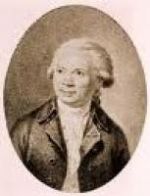
Johann Abraham Peter Schulz was born on March 31st, 1747 in Lüneburg in modern-day Germany and was one of the leading northern European composers in the second half of the eighteenth century.
After his school days in the Lüneburger Johanneum (1757-1764) and studies in Berlin he undertook extended journeys as piano teacher to the Polish princess Sapieha from 1768 to 1772. After a stint as kapellmeister at the French Theater in Berlin Schulz became kapellmeister at the court of Prince Heinrich, brother of Friedrich the Great, in Rheinsberg, where he composed and conducted theater music (for Jean Racine's Athalie, among others), singspiele and operas.
In 1782 his first volume of songs in folk mode appeared, further volumes followed in 1785 and 1790. The composer's desire to be called "songman of the people" came true: "Der Mond ist aufgegangen" and "O Come, All Ye Children" are his most famous songs. In 1786 appeared "Religious Songs and Odes from the Best German Poets".
His successes as kapellmeister were, however, accompanied by private blows of fate; his wife (Friederike Caroline Flügel) and both children died.
From 1787 to 1795 Schulz was commissioned, as royal kapellmeister in Copenhagen (under Christian VII) to expand church music at the court. He also composed the operas Høstgildet (Harvest Celebration, 1790) and Peters bryllup (Peter's Wedding, 1793) for the Royal Theater in Copenhagen during this time. From 1789 on he was teacher of the Altona-born composer Christoph Ernst Friedrich Weyse (1774-1842), who is considered by many to be the father of Danish music.
In 1790 Schulz published the writings "Gedanken über den Einfluß der Musik auf die Bildung eines Volkes" ("Thoughts on the Influence of Music on the Education of the People"). During his time at the Copenhagen court he compsed the passion oratorios Maria og Johannes (1788), Christi Død (1792) and Frelserens sidste stund (1794) as well as the four hymns.
In the 1790s Schulz suffered from advanced tuberculosis. In the hope of relief he traveled northern Germany in his last years; a planned sea voyage to Portugal ended involuntarily after a shipwreck in Norway.
Johann Abraham Peter Schulz died on the 10th of June, 1800 in Schwedt an der Oder.