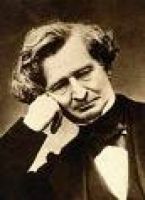
A leading figure of French Romanticism, Hector Berlioz was considered to be an outsider as far as the French musical establishment was concerned and not all his works were well received.
Much against his family’s wishes Berlioz abandoned his medical studies in favour of a career as a composer.
While he was still a student at the Paris Conservatoire, he fell in love
with the Irish actress, Harriet Smithson, who had come to Paris to perform in a season of Shakespeare and they were married a year later.
Berlioz loved literature of great themes and passions and some of his greatest works were inspired by the writings of Byron, Shakespeare and Goethe.
The years following his second marriage to the singer, Marie Recio, were the happiest and most productive of his life. He spent much of his time travelling in Europe, finding audiences outside Paris more receptive to his innovative ideas.
He was admired as a conductor, critic and writer. He wrote two volumes of Memoirs which are a fascinating, if prejudiced, account of musical life in Paris in his time.
ArbeitenIcon Arbeiten
The meadow scene in the Symphonie fantastique of 1830, an orchestral work that contains autobiographical elements and suggests new paths in composition, expresses the great "yearning" underlying the romantic imagination.
This was followed four years later by Harold in Italy, for viola and orchestra, with a narrative programme of literary origin, written for but never performed by the great violinist Paganini.
Concert overtures include a Shakespearean King Lear and two overtures based on the work of Sir Walter Scott’s Waverley and Rob Roy.
His interest in Shakespeare, increased by his love affair and later unsuccessful marriage with the Shakespearean actress Harriet Smithson, had a further result in the dramatic symphony Romeo and Juliet.
The overture Le carnaval romain (Roman Carnival) was derived from his opera Benvenuto Cellini, while Le corsaire has at least Byronic overtones.
He wrote the opera Les Troyens (The Trojans), later divided into two parts, The Capture of Troy and The Trojans in 1858. Excerpts from the opera, the music for the Royal Hunt and Storm, in which the Carthaginian Queen Dido and her Trojan lover Aeneas realise their love for each other, can be heard in concert programmes.
Other important works by Berlioz include the Eight Scenes from Faust, later revised as The Damnation of Faust, one of the most original of a number compositions based on Goethe's drama.
The Christmas oratorio L'enfance du Christ (The Childhood of Christ) is a significant and characteristic work, with the remarkable and extravagantly orchestrated Grande Messe des morts (Requiem) with its brass bands and massed choirs.
Source: karadar.com