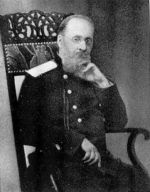
César Cui (*January 18, 1835 in Vilnius, Vilna Governate, Russian Empire (now Vilnius, Lithuania; † March 13, 1918 in Sankt Petersburg, Russia) was a Russian composer, music critic and officer (military engineer-general officer) of the Russian Imperial Army. César Cui was the son of a French officer who remained in Russia after the retreat of Napoleon from Russia. His mother was a Lithuanian. Being that he showed an early interest in music, he received music lessons at the age of ten. However, he did not receive any musical training at a conservatory. His military career stood in the foreground after completion of his engineer studies (fortifications). In addition, Cui still dedicated himself to music. He was known among five Russian composers (Mily Balakirev, Alexander Borodin, César Cui, Modest Mussorgsky , Nikolai Rimsky-Korsakov) who referred to themselves at the ''Group of Five'' or ''The Mighty Handful'' and dedicated to the creation of a Russian national style. Cui emerged especially as a music critic.
The greatest paradox of César Cuis' music is that in his writings he aggressively supported the aesthetic position of the ''The Mighty Handful'' but seldom adhered to these guidelines in his own works. Only occasionally did he employ traditional melodies or empathize with the harmonious and melodious characteristic features of Russian traditional music. Often the national element of his music is completely missing. It may be found within his works the obvious admiration for Robert Schumann. Although Cui composed 15 operas, his musical strength lies more in his songs and piano pieces. His greatest importance was without a doubt as a music critic and he made an impact with his writings on the French impression of the Russian music scene.
(Source: wikipedia)
(Translated into English verbatum from the German version)