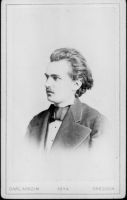
Hugo Richard Jüngst (* February 26, 1853 in Dresden; † March 3, 1923 ibid.) was a choir director and composer.
Hugo Richard Jüngst was born in 1853 as the fourth child of the married couple Friedrich Albert (* April 19, 1812; † March 6, 1871) and Marie Clementine, née Hauffe (* May/June 1816; † September 16, 1885) in the Saxon royal seat in Dresden. His siblings were Armin Moritz (* November 12, 1846; † July 7, 1922), Privatus; Albert Eugen (* November 22, 1845; † February 13, 1930), merchant; Hedwig, Verh. Grünewald (* September 10, 1844; † November 1, 1909), Royal Head Forester.
Jüngst came from a prosperous, middle-class merchant family in Dresden and belonged to the Evangelical-Lutheran Confession. His father was the owner of a factory and warehouse for French millstones, cylinder gauze (sic!) and other articles for mill equipment. Jüngst received his first piano lessons at the age of seven. Being Jüngst was of weak constitution, he was to learn the commercial profession by joining a comptoir at his father's request. However, after his father's death he followed his musical inclinations.
As late as 1871 he entered the Royal Conservatory of Music in Dresden and began six years of study in the special subjects of piano and composition. From 1874 to 1877 he received lessons in freestyle composition from the Royal General Music Director Julius Rietz as his last and supposedly dearest pupil. In addition, he was tutored by the teachers Emil Bähr, Armin von Böhme, Paul Janßen, Gustav Adolf Merkel and Wilhelm Rischbieter in the subjects organ, violin, solo voice and theory.
Already during his studies, Jüngst directed a male quartet which enjoyed performing Jüngst's compositions. In 1875 he took over the direction of the male choral society "Sängerlust" and in 1876 founded the ''Dresdner Männergesangverein'' which he directed until 1904. From 1878 he also directed the ''Julius-Otto-Bund'' which had been founded two years earlier and was the umbrella organisation of the Dresden male choral societies and in the following years became the first national choir master. The Julius-Otto-Bund was named after the famous Dresden Kreuzkantor (cantor) Ernst Julius Otto. In addtion, since 1878 Jünst had been a member of the Dresden ''Tonkuenstlerverein'' in which his father had been a member for a short time before. Jüngst had been Royal Director of Music since 1891 and Royal Professor of Music since 1898. Both titles were awarded to him by King Albert of Saxony for his services for the advancement of German male singing.
In addition, from 1895 to 1915, he was the director of the Erato academic singing group at the Royal Technical University in Dresden. He was able to lead the elitist conservative association of the "Eratonen" to numerous successes in singing competitions. At the end of 1907 Jüngst was elected to the general committee of the German Singers' Association. Moreover, Jüngst was often seen as a judge at the federal singing competitions. In 1913/14 he temporarily took over the management of the Dresden State Railway Civil Servants' Choir Association. Among his contemporaries, Jüngst enjoyed great popularity and esteem throughout his life, so that he received honorary membership in numerous foreign and domestic choral societies. His musical activities extended to Bohemia, Austria, Romania and the United States of America.
Jüngst he received numerous awards, among others he was the bearer of the great club honor pin with precious stones (1901) and the Hugo Younger Medal in silver (1913) of the Dresdner Männergesangverein. Together with the Lord Mayor of Dresden, Otto Beutler, he was appointed honorary member of the Dresden Men's Choral Society in 1901. Toward the end of his life, Jüngst held honorary membership in over eighty choral societies. King Friedrich August III of Saxony awarded him the crown of Knight's Cross 1st Class of the Order of Albrecht and Jüngst was also awarded the Knight's Cross of the Order of the Lion of Zähringen (Baden) and the Medal for Art and Science (Gotha-Coburg). In 1896 Jüngst was the conductor of the ''Weimar CC Singing Festival''. In addition to his activities in numerous choral societies, he was also active as a composer, creating over 300 compositions. Jüngst composed successful male and mixed choirs, choral cycles, single, double and triple voices, piano pieces and orchestral works.
Jüngst's grave for which the Dresden sculptor Albert Starke created a relief, is located at the ''Johannis Cemetery in Dresden-Tolkewitz.
Source: Wikipedia
Note: Translated from the German version of Wikipedia into English.