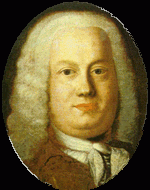
Antonio Caldara (1670-1736) was born in Venice and received his earliest musical training as a chorister of the Cappella Ducale at St Mark's and, probably, as a pupil of Giovanni Legrenzi. By 1689 he was known as a cellist and his growing number of compositions included operas, sonatas da chiesa and da camera, and solo cantatas. Performances of his operas had been given at Venice and Rome by the early 1690s, and a personal visit made to Rome about this time implies an acquaintance with and perhaps instruction from Corelli, Aless, Scarlatti and Pasquini.
His first secure appointment was as Maestro di Cappella (1700-1707) to the Princes of Mantua. There were, however, opportunities for further visits to Rome and the composition of church music and oratorios for Cardinal Ottoboni. This contact was again strengthened in the early part of 1708 after Caldara's return from Mantua and prior to his departure for Barcelona and his first association with the Habsburg dynasty in the person of the Archduke Charles (Charles III). The performance of Caldara's Componimento da camera per musica: Il più bel nome nei festeggiarsi il Nome Felicissimo di Sua Maesta Cattolica Elisabetha Christina Regina delle Spagne at the celebration of Charles' marriage to Elisabeth Christine of Braunschweig-Lüneburg (Barcelona, August 1708) firmly established him as a favourite, and despite his return to Rome to take up the position as Maestro di Cappella to Prince Ruspoli (1709), contact with the Spanish Court was not broken. Indeed, as later developments proved, it was a most fortunate connection.
In the light of Ruspoli's eminence as a patron of the arts, Caldara's appointment as director of the noblemans, distinguished band of virtuosi di canto e suono is proof of an established fame. This is confirmed by a succession of fine oratorios, secular cantates and church music.
Yet despite an obviously secure position, the news of the death of the Habsburg Emperor Joseph I (April, 1711) and the proclamation of his brother Charles III of Spain as Charles VI, Holy Roman Emporer, brought Caldara to Vienna hoping that the earlier favour would secure a court appointment. In the event, the present Vice-Kapellmeister Marc' Antonio Ziani had been made Kapellmeister before Caldara's arrival; Johann Joseph Fux secured the post of Vice-Kapellmeister. Caldara returned to his position in Rome - retained by means of a steady flow of compositions from Vienna - but not before making a detour through Salzburg to court the favour of Franz Anton von Harrach, the Prince-archbishop.
A reshuffling of posts at the Imperial Court upon Ziani's death in 1715 and a more or less firm promise of an appointment brought about Caldara's final break with Rome. He was appointed Vice-Kapellmeister to Charles VI in 1717 (Fux became Kapellmeister) - a position he was to hold until his death in December 1736. The compositions of these last twenty years were prolific in number, diverse in genre, often brilliant and certainly never less than highly competent in quality, mature and personal in expression and style, and above all, secured for Caldara a European fame that lasted long after his death.