Wikipedia:
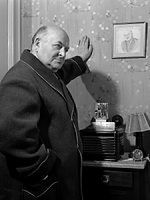
Rudolf Nelson, also Rudolph Nelson (* April 8, 1878 in Berlin; † February 5, 1960 ibid; proper name Rudolf Lewysohn), was a cabaret artist, pianist, composer and theater director who became famous in Berlin in the 1920s, specializing in "minor" art.
Nelson gave up his job as a commercial clerk and also abandoned his musical training to devote himself entirely to work on cabaret stages. With Paul Schneider-Duncker, he opened the ''Roland von Berlin'' on Potsdamer Strasse in 1904 and after separating from Schneider-Duncker (1907), the ''Chat Noir Unter den Linden'' (1908-1914), where he offered a literary-musical cabaret to an upper-middle-class audience.
On December 21, 1909, he married the chansonette Käthe Erlholz (civil name: Katharina Reinholz),[1] who brought their son Hanns Reinholz, born in 1904, into the marriage. Their son Herbert Nelson was born in October 1910.
Nelson also wrote the music for revues performed at the Metropol Theater and composed several operettas. In 1919, he founded the ''Nelson-Künstlerspiele'', which he renamed the Nelson Theater in 1920. For his theater in the building at Kurfürstendamm 217[2], later the "Astor" cinema,[3] he wrote some 30 revues in the 1920s. The splendid, at the same time apolitical Nelson revues were a part of the Golden Twenties in Berlin. The fact that Berlin became the capital of entertainment was due in large part to Rudolf Nelson and his ensemble: Marlene Dietrich, Hans Albers, Claire Waldoff and Willy Prager had sung his songs, Josephine Baker had performed in his theater and Kurt Tucholsky had written lyrics for his countless operettas and revues. One of his most famous compositions is the hit song ''Tamerlan''.
After the Nazis seized power in 1933, Nelson's revue moved to Vienna, but there, too, he was forced out. Nelson went to Switzerland and during a guest performance in Zurich in 1934 he was engaged to Amsterdam.
Here he directed the exile cabaret ''La Gaité'' (roughly: the Cheerful) and made guest appearances during the summer months in Scheveningen. Until 1940, Nelson created nearly 100 programs on a fortnightly basis. Guest appearances by old comrades-in-arms from Berlin days, such as Max Ehrlich, Kurt Lilien, Otto Wallburg or Willy Rosen rounded off the program and made it shine far beyond Amsterdam with their names.
After the invasion of the Wehrmacht, he escaped the deportation of German Jews in a hiding place. At the end of the war he returned to Berlin, and here in 1949 he wrote his last revue ''Berlin-W Weh'' with texts by Günter Neumann. It was directed by Erik Ode.[4] His son Herbert Nelson (1910-1988) was a cabaret writer and administrator of German cabaret in the United States.
Rudolf Nelson was buried in the Waldfriedhof Dahlem.
The extensive Rudolf Nelson Archive is located in the Archive of the Academy of Arts in Berlin.[5]
Note: Translated from the German version of Wikipedia into English.