Wikipedia:
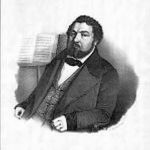
ohann Daniel Elster (* September 16, 1796 in Benshausen, Duchy of Saxe-Meiningen; † December 19, 1857 in Wettingen, Aargau) was a German music teacher and choir director. He founded the first choirs in Thuringia around 1830 and brought them together as the Sängerbund for joint concerts.
The son of a hammer smith, he received his first music lessons from the cantor of his hometown. Recognizing his son's talent, his father gave him to the Suhl cantor Bornemann for further training. He soon eluded the strict teacher and escaped to his parents' home, much to the displeasure of his father, who sent him back. In 1809 Daniel Elster moved to what was to become the Geschwister-Scholl-Gymnasium Freiberg, where he became acquainted with the educational methods, some of which still seemed medieval. The turmoil of the wars of liberation in the Kingdom of Saxony and especially around Freiberg meant that he could no longer attend classes in the fall of 1813, and Elster returned to his hometown. He finally finished his schooling with the Abitur at the Hennebergisches Gymnasium in Schleusingen.
Initially, Elster studied Protestant theology at the University of Leipzig and became a member of the Corpslandsmannschaft Franconia Leipzig in 1816. In 1817 he was one of the founders of the Thuringia II. As a deputy of the Thuringia, Elster participated in the Wartburg Festival in 1817. Because he was frequently involved in student scuffles, he picked up a smack in a duel that made further study of theology impossible and he transferred to medical school. Eventually, another scuffle in the city - in which he was not even involved this time - earned him the consilium abeundi and police expulsion from Leipzig. He continued his studies at the University of Jena; however, he no longer felt safe in Jena after the assassination attempt by the fraternity member Karl Ludwig Sand against the poet August von Kotzebue (March 23, 1819). He decided with a friend to emigrate to South America and join Simón Bolívar's liberation struggle.
Traveling through the Netherlands and in London, they tried in vain to obtain enlistment to South America. When they tried to reach it from France, they were picked up in Paris and pressed into the Légion étrangère. They were then taken to Corsica, where Elster's musical talent made this torturous time easier. He was able to excel here as an orderly to an officer in Rogliano (Corsica) as an organist, where the local council managed to get Elster a leave of absence from military service. He improved his financial situation by teaching. Nevertheless, he risked an escape attempt, which failed. After his arrest, he joined a music corps in Bastia as a flautist. There, a piano concert brought him cheers, money, and new pupils, including the wife of his colonel, who helped him to freedom. At the next medical visitation, he was written "unfit."
In Würzburg he continued his studies; however, through no fault of his own, he got into a duel. Thinking that he had killed his seriously injured opponent, he fled again. Thereupon he joined the Philhellenes. With them he went to the liberation struggle of the Greeks against the Turks. He was able to use his medical knowledge and served as a battalion surgeon. In the battle of Peta, his battalion was ambushed by treachery and was completely wiped out. Daniel Elster managed to escape together with 17 of his comrades. In Germany, however, it was felt that none had survived and Elster's childhood sweetheart Rosine Bohlig (nicknamed "Röschen"), the daughter of a wealthy Benshausen wine merchant, agreed to marry an Arnstadt merchant named Schierholz, which her parents had been demanding for some time. On his wanderings through Greece, Elster finally landed in Smyrna.
He arrived in Basel in 1823 via Marseille and Geneva and found his first job as a piano teacher. Shortly thereafter he received an appointment at the Lenzburg Teacher Training Institute and joined the circle around Hans Georg Nägeli and Heinrich Pestalozzi. In close collaboration with his teacher and fatherly friend Hans Georg Nägeli he worked on the improvement of popular singing. In 1825 he received a teaching position in Baden/Aargau and founded the first Baden men's choir here in 1826.
After learning of his father's death and of Röschen's husband in two letters in 1827, he was drawn back home, where he married Rosine Bohlig. His new circle of friends consisted of Meiningen's Ludwig Bechstein and Andreas Zöllner, the Benshausen superintendent Dr. Holzapfel, Ludwig Storch from Ruhla, the bookseller and publisher Conrad Glaser from Schleusingen, and others. Together with his wife Rosine, he managed her father's estate in Haubinda, in the Heldburger Unterland, and the post office in Hildburghausen, which they established as the inn "Zum Sächsischen Hause". In Haubinda he received a nightly serenade from village boys, which gripped him and reminded him of his choral work in Switzerland.
With this memory, he advertised for a men's choir in the surrounding villages. After six months of rehearsal, a male choir of 360 singers gathered on the Hildburghausen town hill and gave their first rehearsal of the skills they had acquired in the church of the village of Eishausen. The festive performance of the rehearsed songs took place eight days later in the town church of Hildburghausen.
Daniel Elster continued to work together with the bland head teacher Hummel and soon had won over thirty village communities. On March 28, 1832, a performance took place in the main church of the state residence. The choir had grown to 600 men. The first tenor was filled with 175 voices and the second bass numbered 200.
On June 2, 1834, his beloved wife Rosine died of smallpox. In his grief, Elster began to complete the opera Richard and Blondel, which had been preconceived in Switzerland and premiered at the Meiningen Theater in December 1835.
Wettingen Monastery, where Elster worked as a music professor
In an effort to compose more operas, he followed friendly advice and learned opera practice as a Kapellmeister. His first engagement took him to Bamberg, where, like his predecessor E.T.A. Hoffmann, life was made difficult for him by indiscipline and ill will. He then traveled through various cities in Saxony with a traveling opera and acting troupe. In 1839 he obtained a position as theater conductor in Zurich. He met his former pupil Franziska Lang again and married her in the summer of 1840.
In 1846 Elster was again offered a position as professor of music at his old post, the teachers' seminary in Lenzburg, which shortly thereafter (1847) was moved to the dissolved monastery in Wettingen. Daniel Elster published his Volksgesangschule in Baden/Aargau in 1846.
From 1847 to 1851 he directed the large Freiämter Singers' Association. In recognition of his services, Switzerland granted him citizenship in 1849. Already stricken by serious illness, he directed the Aargau Cantonal Singing Festival in 1857. At the age of 61, he succumbed to liver disease in Wettingen.[6][7]