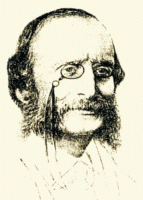
Jacques Offenbach (1819-1880) was born Jacob Eberst, the son of Isaac Juda Eberst, a synagogue cantor, bookbinder, music teacher and composer. His father was living in Köln in 1807 when the Napoleonic edict required Jews to take inheritable family names, and he took the name of Offenbach since he was already known there as "Der Offenbacher".
Jacques moved to Paris in 1833 to study the cello. He found employment playing cello in the orchestra of the Opera Comique, and wrote several pieces for his instrument. In 1844, he married Herminie de Alcain. In 1850 he became conductor of the Theatre Francais, but in 1855 rented his own theatre, the Bouffes Parisiens on the Champs Élysées, and began a successful career devoted largely to operetta and opéras comiques until his death. His most popular works are still performed regularly today. He also wrote much dance music, especially the can-can style. His best known operettas in the English-speaking world are Orpheus in the Underworld, La Vie parisienne, La Belle Hélène, La Périchole and The Grand Duchess of Gerolstein.
Offenbach's final opera, The Tales of Hoffmann, was more serious than his other works, reflecting perhaps the eternal wish of the clown to be taken seriously. It was still unfinished at his death, and was completed by his best friend Ernest Guiraud, and premiered in 1881.
He is buried in the Cimetière de Montmartre, Paris, France.