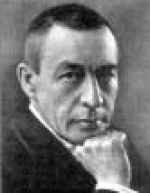
Sergei Rachmaninoff (1873-1943) was born in Semyonovo, near Novgorod into a wealthy family with a strong military background. He had his first piano lessons with his mother at the family estate at Oneg. After a decline in their fortunes, the family moved to Saint Petersburg where Rachmaninoff studied at the Conservatory, before going on to Moscow, where he studied piano with Nikolay Zverev and Alexander Siloti (a student of Franz Liszt and Rachmaninoff's cousin). He also studied harmony with Anton Arensky and counterpoint with Sergei Taneyev. While still a student he wrote a one-act opera, Aleko, and a set of piano pieces, Op. 3, which contains the popular and famous Prelude in C sharp minor, a piece he came to detest through 40 years of audiences demanding it as an encore at his piano recitals. Already in his early years he showed great composing skills. His first serious pieces for the piano were composed and performed when he was thirteen years old during his stay as student at Zverev's. In 1892, at the age of 19, he completed his first piano concerto. The Concerto was later revised in 1917.
Rachmaninoff's First Symphony was premiered in 1897, but was a complete flop with the critics. Some have suggested that this was largely due to the conducting of Alexander Glazunov, who disliked the piece and under-rehearsed it. Rachmaninoff's wife later suggested that Glazunov may have been drunk. This disastrous reception, coupled with his distress over the Orthodox church's objection to his marrying a cousin, Natalia Satina, led to a nervous breakdown. He wrote little music until he began a course of autosuggestive therapy with psychologist Nikolai Dahl. Rachmaninoff quickly recovered his confidence; one result of these sessions was the Piano Concerto No. 2, written 1900/1901, which Rachmaninoff dedicated to Dr. Dahl. The piece was very well received at its premiere, at which Rachmaninoff played the solo part himself, and remains one of his most popular compositions, gaining fame from its use in the films Brief Encounter and The Seven Year Itch as well as in popular songs in the 1940s. Rachmaninoff's spirits were further bolstered when, after years of engagement, he was finally allowed to marry Natalia. They were married by an army priest in 1902; their happy union lasted until the composer's death.
Rachmaninoff was offered a job as conductor at the Bolshoi Theatre in 1904. Political reasons lead to his resignation two years later. In 1908 he moved to Italy and later to Dresden while waiting for the situation in Russia to normalize.
The Second Piano Concerto secured Rachmaninoff's reputation as a composer, but he was also a very well known and highly respected pianist. His technical perfection and rhythmic drive were legendary and his large hands were able to cover a twelfth. He made many of recordings of his own music as well as the standard repertoire.