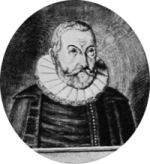
Eccard came from Mühlhausen in Thuringia. In humanist style, he wrote himself "Johannes Eccardus Mulhusinus". He was a choirboy in the court chapel in Weimar and then in the Munich court chapel until 1574 as a pupil of Orlando di Lasso. He had already produced two collections of song compositions when he received his first appointment in 1576-1579 as organist in the Fugger household in Augsburg. In 1580, he followed an appointment to Königsberg as Kapellmeister to the Duke of Prussia. The Duke was ill and his cousin, Margrave Georg Friedrich von Ansbach-Bayreuth, who also had his own chapel under Theodoro Riccio, ruled in his place. Eccard was initially deputy conductor and remained so after Riccio's departure, only becoming court conductor in 1604. The Duke of Prussia was a strict Lutheran; Eccard's task was primarily church music. At times, his orchestra consisted of 5-7 professional singers (alto, tenor, bass), 5-6 choirboys (discantus) and 2-3 instrumentalists.
Eccard's compositions appeared in print in several collected works, and he also created numerous occasional pieces, mostly for weddings. Some works were only published after Eccard's death, edited by his colleague and former pupil J. Stobaeus. Eccard's fame was based on his mastery of ornate song composition.
In connection with a change of government, Eccard became the Electoral Brandenburg Court Kapellmeister in Berlin in 1608. No compositions are known from this period until his death in 1611.