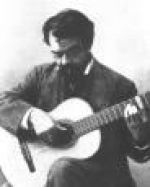
Francisco Tárrega (1854-1909) was a Spanish guitarist and composer. He received his first guitar instruction at the age of eight. Since at the time the piano was becoming more popular than the guitar, his father recommended that he learn the piano as well, so that he quickly mastered both instruments. In 1866 he began studying with the famous guitarist Julian Arcas.
In 1869 he obtained a modern guitar with longer string length (65 cm) which was unusually loud and sonorous. In 1881 he moved to Barcelona, where he met Isaac Albéniz and Enrique Granados. They became friends, and he was the first to transcribe many of their compositions for guitar. Tarrega became the most famous guitarist and teacher of his era. He founded the so-called new Spanish guitar school, characterized by a powerful and huge sound, which he obtained by using new playing techniques. Most of these, including the position of the guitar on the left thigh, the apoyando attack and the position of the plucking finger in relation to the strings, are still in use.
His compositions include numerous etudes and dances, arrangements of works by Bach, Händel, Beethoven, Haydn, Mozart, Chopin, Schubert and Schumann. One of his most popular melodies from his Gran Vals may be heard today as a Nokia cellphone ringtone.