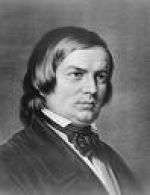
The son of a bookseller, publisher and writer, Robert Schumann showed early talent in both music and literature, and became not only a composer but an influential music critic.
After brief study at university, he was allowed by his widowed mother and guardian to undertake serious study of the piano with Friedrich Wieck, whose favourite daughter Clara Wieck was later to become Schumann's wife.
His ambitions as a pianist were thwarted by a weakness in the fingers of one hand, but Clara inspired a number of compositions for the instrument in the 1830s.
The year of his marriage, 1840, was a year of song, followed by attempts at more ambitious forms of orchestral composition, in which his young wife encouraged him.
Settling first in Leipzig and then in Dresden, the Schumanns moved in 1850 to Duesseldorf, where Schumann had his first official appointment, as municipal director of music.
In 1854 he had a serious mental break-down, followed by two years in the asylum at Endenich before his death in 1856.