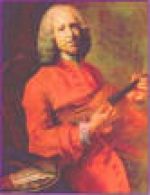
Jean Philippe Rameau(1683-1764) first studied music with his father, a professional organist. He attended a Jesuit school and then studied in Italy. In 1702 he was appointed maître de musique at Avignon Cathedral, but later in the same year transferred to Clermont Cathedral. By 1706 he was in Paris as organist of the Jesuit college. He returned to Dijon in 1709 as organist at Notre Dame (a shared position), but by 1713 he was in Lyons and in 1715 he was back in Clermont with a 29-year contract as organist. By 1722, however, he was in Paris, where he was to remain.
He had left Clermont to supervise the publication of his Traité de l'harmonie, a substantial, famous, and controversial work, particularly as regards his new theory, based on his understanding of the physical properties of sound, on the relationship of bass to harmony.
As a composer, he was known only for his keyboard music (a second collection appeared in 1729-30) and his cantatas, although he had also written some church music. Rameau's harpsichord music is notable for its variety of texture, its originality of line and its boldness of harmony.
His ambitions, however, lay in opera; and at the age of 50, in 1733, he had his first opera, Hippolyte et Aricie, performed at the Opéra. It aroused great excitement, admiration, bewilderment and (among the conservative part of the audience who saw no good in anything since Lully) disgust.
It was fairly successful, as were the other operas that followed in the ensuing years; his opéra-ballet Les Indes galantes had 64 performances over two years, and the least successful Castor et Pollux, an initial run of 21 performances.
Rameau had various patrons, notably the financier La Pouplinière. He moved in intellectual circles and counted Voltaire among his friends. In 1745 he was appointed a royal chamber music composer; thereafter several of his works had their premieres at court theatres.
Nine new theatre works followed in the mid-late 1740s, beginning with La princesse de Navarre and the comedy Platée. His operas anticipated Gluckian reform by relating the overture to the ensuing drama. Diderot praised his ability to distinguish the tender, the voluptuous, the impassioned and the lascivious. His recitative, while following the Lullian model, is more flexible in rhythms and more expressive in its declamation. Such tragedies as Hippolyte et Aricie and Castor et Pollux, with their noble characters and their eloquent lines, harmonies and orchestration, supported by skilfully placed divertissements that strengthen rather than dilute the force of the action, stand among the great creations of French musical drama.
But from 1750 onwards only two major works were written, for Rameau was increasingly involved with theory and with a number of disputes, with Rousseau, Grimm and even former friends, pupils and collaborators such as Diderot and D'Alembert. By the time he died in 1764 he was widely respected and admired, even though he was also seen as unsociable and avaricious.