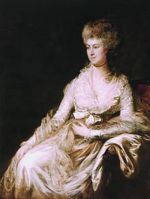
Francesca (Franziska) was the first child of the court musician Innocenz Danzi (around 1730-1798). She received singing instruction like her brother Franz Ignaz Danzi also, first from her father and she learned composing from Georg Joseph Vogler. Later she probably got singing instruction from the primadonna of the court opera Dorothea Wendling (born Spurni), perhaps also from the tenor Pietro Sarselli, who was friendly with the family. Already at 16 she became a member of the Mannheim court chapel and gave her debut as Rosina in “L'amore artigiano” from Florian Leopold Gassmann in Schwetzingen, the summer residence of the electoral prince and princess Karl Theodor and Elisabeth Auguste. In May 1778 she married her colleague Ludwig August Lebrun in London. With transfer of residency for Karl Theodors after the death of the Bavarian electoral prince Maximilian III., the young married couple went to Munich and Franziska Lebrun was a guest at various well-known opera houses of Europe.
In Milan, Paris, London, Vienna, Prague, Naples, Munich and Berlin the singer was enthusiastically celebrated. Particularly known were the perfectly co-ordinated instrumental and vocal artistry of the married couple Lebrun who pay tribute to numerous composers through arias with an obligate oboe, like for instance Ignaz Holzbauer in Günther von Schwarzburg (1777), Antonio Salieri in L'Europa riconosciuta (1778) or Georg Joseph Vogler into CAS gates e Polluce (1787).
Franziska Lebrun ranked among the few appreciative female composers in a time, in which for women the musical career rather was reserved for being a singer or instrumental virtuoso. From her works however only few were kept, among them some sonatas for violin and piano.
After the death of her husband in December 1790 she had to provide for her two daughters. To cover living costs Karl Theodor paid his celebrated primadonna of the court opera a remuneration of 1,500 guldens contrary to court music bylaws. She could no longer perform her schdueled commitment of 1790 at the Royal Opera in Berlin. In May 1791 the singer died. She could clearly not endure the death of her husdand.