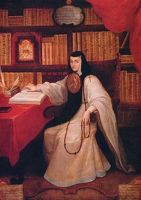
Juana Inés de Asbaje y Ramírez was the extramarital daughter of Manuel de Asbaje and Isabel Ramirez. Already at the age of three she learned to read and studied in the areas of philosophy, astronomy and medicine.
At the age of 16 this talented girl was discovered by the vicereine of New Spain, whom she brought to her court. As a result, Juana wrote numerous poems in Spanish, Latin and the indigenous language of Nahuatl. Because of her graceful verses, she is today one of the most important Latin American poets of the 17th century.
After a visionary dream she joined a convent in 1667 and took the name of Sister Juana Inés de la Cruz.
Monastic life was very good to her, thus she had a spacious apartment, library and laboratories for experiments. Still under the patronage of the vicereine, she was allowed to receive guests whenever she wanted. She continued to write "secular" poems of passion, of which she devoted most to the vice queen.
Her superiors urged her repeatedly to deal only with religious literature. In letters to her confessor and to the Bishop of Puebla she campaigned for women's right regarding learning and education. In 1694 she gave in to pressure and signed a confession and a vow from then on only to live for God. When the plague broke out in 1695, Sister Juana Inés de la Cruz became infected while treating the ill and soon after died from the plague.
She used elements and instruments of Aztec folk music in her composition.