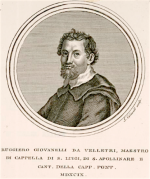
Ruggiero Giovannelli was born around 1565 in Velletri, Italy, and died on Jaunary 7, 1625 in Rome. He was an Italian singer, music director and composer.
It has been claimed that he was a student of Palestrina but there is no documentary evidence of this. After having worked at various churches as a musical director, he was appointed in 1594 as the successor to Palestrina in the position of musical director, ''Capella Guila de San Pietro'' (Julian Chapel at St. Peter's) . As of 1599, he worked as a singer and musical director at the ''Capella Sistina'' (Sistene Chapel). He lived and worked in Rome until his death in 1625. (Wikipedia).
Ruggiero Giovannelli initially distinguished himself as a composer of secular works. Villanelles, Madrigals, and Canzonettes were his musical expression. He became within a short period of time a star on European stages. Gassenhauer would of had to been his Madrigal. He mastered the keyboard in the prevailing taste and style of the time period. His work in distant England even became a model for light and modern Madrigals. His career in Rome was also astonishing. His first commitment at the French national church ''San Luigi die Francesi'' led him to be the ''Maesto di capella'' where he was given the task to develop a small, insignificant chapel orchestra into one of the most distinguished music ensembles in Rome. He mastered this task with flying colors and after a brief stopover at the ''Collegium Germanicum'' he ultimately became the successor of Giovanni Pierluigi da Palestrina as music director of the ''Capella Guila at S. Pietro''.
Encouraged by numerous patrons he was bestowed the highest honor in the life of a Roman musician: By initiative of the responsible cardinal he was appointed singer (tenor) of the ''Capella Sistina''. He enjoyed a high-level of esteem here as well and was unchallenged as a musical authority. The singers could hardly wait to select him as their church musical director after completion his statutory retention period of 15 years.
An attempt was made to place him in this position already one year before the end of the 15-year period but failed as a result of objection by the responsible cardinal. And so an additional year passed until the Pope's choir was permitted to appoint Ruggiero Giovannelli on January 14, 1614 as ''Maestro di capella'' which occurred under great rejoicing and intense embraces.
At the pinnacle of his career as a musician followed the decisive rift in the life of Giovannelli. The manner in which he executed his position caused the singers to turn against him. It came to a public scandal within a few weeks after his being appointed to the position. His rivals under the leadership of the singer Paolo Facconio forced him out of the position. Facciono accused Giovannelli during the time he was in the position of ''Carmerlegno'' from 1610 until 1613 as not having correctly paid him his wages. On April 27, 1614, a commission was convened to review the accounting books. The results of the audit are not recorded in the diaries of the ''Capella Sistina''. In any event, Giovannelli lost his position to his challenger, Paolo Facconio during the next vote.
Giovannelli took over the musical direction of the ''Capella Sistina'' in September 1615 for several months after the death of Facconio and accordance with bylaws. His three attempts in 1616, 1617, and 1622 to once again become the church music director were unsuccessful.
Giovannelli retired as the so-called ''Giubilato'' on April 7, 1624, exactly after 25 years to the day in service of the Pope's choir. A few months later on January 7, 1625, the ''Diarium'' noted the death of Ruggiero Giovannelli. He was interred on the grounds of the present Vatican in ''Santa Marta dietro San Pietro''. The exact site can no longer be located as a result of various reconstructions and alterations of the church. (Christian Saalfrank)