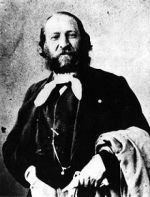
Sebastián de Yradier (actually: Sebastián de Iradier y Salaverri) (* January 20, 1809 in Lanciego, Álava (Basque region), Spain; † December 6, 1865 in Vitoria) was a Spanish composer.
After having initially worked as an organist at the parish church of Salvatierra, Sebastián de Yradier taught singing at the ''Madrid Conservatory'' commencing in 1833. In 1850 he relocated to Paris. At the urging of his publisher in Paris, he changed his name to Yradier in order to make himself more cosmopolitan. During a trip to the Caribbean in 1857 he occupied himself with Creole rythyms and especially the Habanera. Having returned to France, he published several collections of compositions with Zarzuelas, Habanera and songs. These collections contributed to making the Habanera popular in Europe during the 19th century. In 1865 Yradier returned to Spain and died there in same year.
Among his numerous compositions only ''La Paloma'' and ''El arreglito'' gained wordwide fame after his death.
'La Paloma'' is the piece which is most of all sung, interpreted, arranged and recorded. In Germany it is closely associated with the romanticism of the seafarer and was sung by Hans Albers and Freddy Quinn numerous times in movies such as ''Große Freiheit Nr. 7'', ''Auf der Reeperbahn nachts um halb eins'' and ''Freddy und der Millionär''. The text written by Helmut Käutner in 1943 for the film ''Große Freiheit Nr. 7'' has established itself.
'El arreglito'' was considered by Georges Bizet to be traditional folk music which he highlighted in the aria of the opera ''Carmen'': ''L'amour est un oiseau rebelle''.