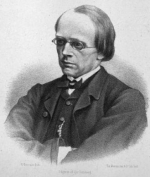
from Wikipedia:
Halfdan Kjerulf (* 17 September 1815 in Christiania; † 11 August 1868) was a Norwegian composer.
Kjerulf originally studied law in the tradition of his father. However, shortly before his exams in 1839, he became seriously ill and went to Paris for recuperation in the summer of 1840. Here he came into contact with the active musical life of Viennese Classicism and the early music of the Romantic period. Kjerulf heard Hector Berlioz.
Kjerulf's sister died in the winter of 1840/1841 as did his father and brother. As the eldest child he had to provide for the family and became a foreign correspondent for the Norwegian newspaper ''Den Constitutionelle. During this period in the autumn of 1841 his first composition was composed. In 1845 he finished his journalistic activity and became a music teacher. Kjerulf studied music theory with Carl Arnold. He received scholarships in Copenhagen with Niels Wilhelm Gade and later in Leipzig where he completed his training at the age of 35.
1851 he returned to Christiania and became a music teacher again. In the last years of his life Kjerulf was plagued by illness.
While his romances and choral songs are best known today Kjerulf also wrote many works for piano. The influence of German Romanticism (Schumann and Mendelssohn) is most significant in Kjerulf's works. At the same time, the influence of Norwegian folk music should not be underestimated. Along with Glinka, Kjerulf was the first European musician who unlike all other composers of the first half of the 19th century used modal elements not only for church music but also ecclesiastical music.
Note: Translated from the German version of Wikipedia into English.