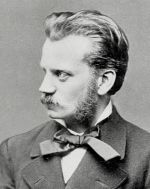
Becker, Karl Reinhold
violinist, composer, choir director
* 08/11/1842 Adorf/Vogtland
† 12/04/1924 Dresden, Urnenhain Tolkewitz
Becker was born as the fifth of eight children in the Adorf in Vogtland (Kingdom of Saxony). When his father, a respected lawyer, died of pneumonia at the age of 45, Becker was only six years old. The mother alone could not manage the upbringing of the eight children, so that in 1848, in the middle of the stormy times of the revolution, Becker moved to Dresden to the care of his uncle's family. His uncle, who was probably the "string instrument maker" Wilhelm Ehrlich, was a violin maker, which also brought Becker into contact with music. Thus his musical education in the subjects music theory under Ernst Julius Otto and violin under Winterstein began very early. He made rapid progress and gave his first public concert at the age of nine. The encounter with the violin virtuoso Louis Eller in Dresden in 1860 was formative for Becker. Becker had just decided to move to Berlin to continue his musical education when Eller asked him to come with him to the south of France. With the prospect of taking over the position of second violin in Eller's quartet, Becker finally decided on the French Pau. He spent ten happy and also very successful years there, as numerous sources prove. But due to the Franco-Prussian War, he was finally forced to return. Back in Dresden, Becker's already existing handicap worsened, probably a consequence of the many practices. He soon had to give up his virtuoso activities and devoted himself increasingly to composing. He also gave music lessons in the subjects violin, piano and harmony. One of his students was his later wife Olga Haebler, the daughter of a merchant. At the wedding in the Dresden Frauenkirche, the Dresden Liedertafel performed a new composition by Becker, the sacred song "Wo du hingehen, da will auch ich hinhn" which he had composed especially for his wife. Becker had already taken over the direction of this male choir in 1884. He rehearsed with him both his own compositions and works by other composers, such as the choral passages from Richard Wagner's "Parsifal". Musical highlights during his ten year Liedertafel period included the choir's participation in Wagner's funeral service on February 13, 1883, in the Philharmonie in Berlin and its homage to Otto von Bismarck on May 21, 1892 in Friedrichsruh. The association and its conductor had even attracted attention abroad. However, an offer from America had to be turned down as many of the association members could not take time off for a two and a half month tour. On the occasion of the anniversary celebrations of the ''House of Wettin'', Becker was appointed professor in 1898. He conducted the performance of the hymn he had composed at the celebration on the Schlossplatz in Dresden. The following years were marked by musical activities, a large circle of friends, including Mathilde Wesendonck and the then dramaturge of the Dresden court theatre Franz Koppel-Ellfeld and his private happiness with his wife Olga. He continued to compose even after his blindness, which began in 1906 and was due to a damaged eye from childhood. His wife meticulously noted down his compositions. Becker received a special tribute in 1923 when a memorial plaque was dedicated to him on the 24th of June at his birthplace in Adorf/Vogtland. After the increasing deterioration of his health he finally passed away on 12/04/1924. Becker's compositions include about 200 songs, the two operas "Frauenlob" and "Ratbold", piano works, a symphonic poem and two violin concertos. Many of his songs were not only performed publicly during his lifetime but also found their way into popular singing. He achieved special merits in the field of German male voice whose repertoire was still quite sparse in the 19th century. Since Felix Mendelssohn Bartholdy who devoted a great deal of attention to male vocals, the leading composers had scarcely dealt with them. All the more fruitful was therefore the work of Becker's who made a name for himself with a total of 60 compositions and arrangements for male choirs. But Becker was also successful with his two operas. Both were premiered in Dresden at the Court Opera under the musical direction of Ernst von Schuch: "Frauenlob" on 12/08/1892 and "Ratbold" on 03/05/1898. Due to the exceptionally good aclaim performances followed in cities such as Berlin, Mainz, Cologne, Aachen and Posen (Poznań in Polish).
Source:
http://saebi.isgv.de/biografie/Reinhold_Becker_(1842-1924)
Note: Translated from the German source document into English.