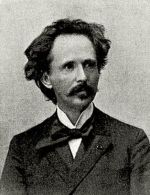
Jean Baptist Joseph Franz Henry Curti (* November 16, 1854 in Kassel; † February 6, 1898 in Dresden) was a German opera composer.
Franz Curti was the son of the lawyer and court opera singer Anton Curti (1820-1887) and his wife, Marie Clementine, née Gräbner (1827-1898). Since his father had many engagements in European opera houses, From 1864, Franz Curti was raised by his uncle in Rapperswil, Switzerland, on the shores of Lake Zurich. In addition to school lessons, he also learned to play the piano, organ and violin. After graduating from high school in 1871, he travelled to Italy to recover from a lung disease and was fascinatedby the performance of opera there.
He completed his subsequent studies of medicine in Berlin in 1880 with the state examination and then opened a dental practice in Dresden. In addition to his profession, he took composition lessons with Edmund Kretschmer (1830-1908) and Heinrich Schulz-Beuthen (1838-1915). As early as 1882 Curti published his first work, "Die Gletscherjungfrau", and his first opera "Hertha" was awarded the Gold Medal for Art and Science by Duke Ernst I of Saxony-Altenburg in 1887. The international breakthrough came in 1896, two years before his death, with the opera "Lili-Tsee". Curti did not live to see the premiere of his last opera "Das Rösli vom Säntis" in 1898 [1] as he died in the same year at the age of only 44 years. He left behind many song and choral works which were very much influenced by German Romanticism. They also repeatedly dealt with Switzerland, which he felt to be his home and which found great resonance there [2].
Curti had been married since 1880 to the daughter of the Dresden art historian Friedrich von Boetticher, Eugenie von Boetticher (born 1858)[3]. The couple had four children: Johanna Eugenie (1881-1957), Friedrich Albert (1883-1949), Hertha (1887-1978) and Reinhard Johannes (1890-1972).
Curti was buried at the Johannis cemetery in Dresden.
Source: Wikipedia
Note: Translated from the German version of Wikipedia into English.