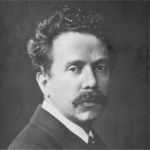
Robert August Kahn (*July 21, 1865 in Mannheim; †May 29, 1951 in Biddenden, Kent, England) was a German composer and music teacher.
Robert Kahn was one of nine children of a rich and respected Jewish merchant and banker family in Mannheim. His father was Bernhard Kahn and his mother Emma Eberstadt (daughter of Ferdinand Eberstadt) who had moved from Worms to Mannheim. His brother was the banker Otto Hermann Kahn.
Kahn studied music at the Royal Academy of Music in Berlin from 1882 to 1885, among others under Friedrich Kiel and in 1885/86 under Josef Rheinberger in Munich. His personal encounter with Johannes Brahms in 1886 was formative for him.
After military service, Kahn lived in Berlin as a freelance composer and chamber musician until 1890. From 1890 to 1893 he was a répétiteur at the municipal theatre in Leipzig.
In 1894 Kahn became a lecturer at the Royal Academy of Music in Berlin, where he was professor from 1903. Among his most famous students were the pianist Wilhelm Kempff,whom he taught composition from 1904, the conductor, pianist and music teacher Eduard Zuckmayer, the conductor Ferdinand Leitner, the composers Günter Raphael (from 1922) and Nikos Skalkottas and the violinist Karl Klingler. Arthur Rubinstein also attended his music theory courses. In 1900 he married Katharina Hertel who was granddaughter of the composer Peter Hertel.
Memorial plaque at the house, Pariser Platz 4, in Berlin-Mitte
Practically all his time in Berlin he was active as a chamber music partner and song accompanist to the leading interpreters of his time; from Joseph Joachim and Richard Mühlfeld to Adolf Busch and from Johannes Messchaert to Ilona Durigo and Emmy Destinn.
In 1916 Kahn was appointed a member of the Prussian Academy of Arts of which he was a member until 1934.
Kahn as a Jew was forced into emigration by the National Socialists. When he emigrated to England in December 1938, he was already known in Germany as a composer and had published numerous works. He spent the remainer of his life in England.
After the end of the Second World War, Robert Kahn was almost completely forgotten by the wider musical public. In 1985, the Badische Kommunale Landesbank and Deutschlandfunk in Mannheim organized a concert entitled "Once Celebrated, Then Forgotten"[1] in which Donald Runnicles performed Kahn's early piano pieces (including op. 11) and recorded them for an LP record. Around the turn of the millennium, Kahn's music increasingly attracted the attention of various performers. A recording of the first piano quartet with Triendl, Shaham et al. was released. In the interpretation of the tenor Martin Dillon (1957-2005), an extensive collection of Kahn's songs - including the complete ''Jungbrunnen cycle op. 46'' for voice and piano trio - was also recorded on 2 CDs; a third planned CD was not produced due to Dillon's death. 2] Kahn's first ''Cello Sonata op. 37'' was recorded by R. Rust and F. Schwinghammer, his ''Clarinet Trio op. 45'' by the Trio Paideia and, most recently, the Trio Bornalie (2005), and the ''Serenade op. 73'' has since been recorded by the Trio de Vries, Janssen, Guittart (2002). Four of Kahn's six works for piano trio were recorded by the Hyperion Trio in 2012.
Robert Kahn moved into his country house in Feldberg after his retirement and lived there for the last few years until his expulsion from Germany. The house is now used as a youth hostel. There is a memorial plaque on the west side of the house commemorating him.
Source: Wikipedia / Photo : robert-kahn.de
Note: Translated from the German version of Wikipedia into English.