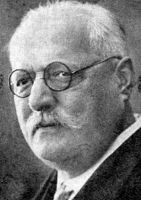
Hugo Wilhelm Ludwig Kaun (* 21 March 1863 in Berlin; † 2 April 1932 ibid.) was a German composer, conductor and music teacher. His works enjoyed the highest esteem in Germany and America.
His father Johann Ludwig Kaun (1830-1886) was a textile manufacturer from Konitz in West Prussia. His mother Emma Albertine Wilhelmine was a born Kräutlein (1841-1926). Hugo Kaun's marriage to Clara Friedrich (1865-1954) produced five children: Bernhard, Martha, Margarethe, Maria and Ella.
Hugo Kaun's school days at the Andreas-Realgymnasium in Berlin were followed in 1876 by the study of music. He received his first musical education in his hometown Berlin, where he studied music and piano with Oskar Raif and, from 1879, composition with Friedrich Kiel at the Royal Academy of Music, founded in 1869. He was expelled from the college for repeatedly truanting up his classes. He then did his military service and subsequently founded a music publishing company. In 1887 he left for the United States of America.
In Chicago Kaun studied with the German-American music theorist Bernhard Ziehn, with whom Wilhelm Middelschulte also received his training. Later he taught, as did Middelschulte, at the conservatory there. This was followed by activities as a music teacher, conductor and composer in Milwaukee, Wisconsin and other places until 1901, as well as founder and conductor of the Milwaukee Liederkranz and as director of the Festival of the Northwestern Singers' Association. Under the pseudonym of Ferdinand Bold, Kaun also wrote sophisticated light music in economically difficult times. His friend Theodore Thomas, founder and conductor of the Chicago Symphony Orchestra, provided for the performance of his three symphonies in America.
In 1900 he returned to Berlin and lived at Schwerinstrasse 25 (renamed Kaunstrasse on 20 March 1937) in Zehlendorf. The family followed two years later. By this time Kaun had written his Opus 49. After he had been accepted as a teacher at the Royal Academy of Arts in Berlin, he was appointed professor in 1912. From 1922 to 1932 Kaun taught composition at the Klindworth-Scharwenka Conservatory. He also continued his extensive teaching activities in a private capacity. His composition students were Heinrich Kaminski, Hans Uldall, Walter Gronostay, Max Donisch, Walter Morse Rummel and his youngest son Bernhard Kaun.
Hugo Kaun died in 1932 at the age of 69 in Berlin. He is buried at the Zehlendorf cemetery. At the gravestone there is a bronze relief with a portrait of Kaun in profile. The grave of Hugo Kaun is located at the cemetery Berlin Zehlendorf.
Work
Hugo Kaun is regarded as a modern late romanticist who felt himself and his music to be "German". The contemporary critics agreed with him. In many of his works he consistently applied the harmony principles of his teacher Bernhard Ziehn, namely the symmetrical inversion. He himself was close to Max Reger and Hans Pfitzner. In contrast, he regarded the music of Arnold Schönberg disparagingly.
From 1920 Kaun's compositional style changed significantly; these late works represent a symbiosis of sound and style consisting of Wagnerian expressiveness on the one hand and elements of Impressionism on the other. The fact that Kaun's music was played particularly often after his death in the Third Reich is solely due to the unfortunate fact that he was a good friend of Peter Raabe, the later director of the Reich Chamber of Music and dedicatee of his 2nd Symphony. Thus his works, especially the women's choirs a cappella and operas, were often heard, even until the end of the 1930s.
An intensive, musicological reappraisal of Kaun's complete works is still to come.