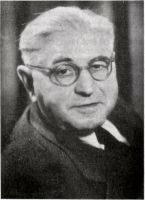
Eisenmann was the last of three children to be born from the marriage of the teacher Christian Eisenmann (1865-1910) and Friede Pilhofer, the daughter of the mayor of Eschenfelden. He attended elementary school in Postbauer. At the age of ten he received his first piano and violin lessons from his father. At the age of 14 he came to Neustadt an der Aisch where he also attended the taxidermy school like his older brother Georg. Just as Georg, Rudolf also attended the Royal Bavarian Teachers' Seminar in Altdorf near Nuremberg which he successfully completed in 1913.
Even before being called up for military service in France and Russia, he was a substitute teacher in Poppberg until 1915. Already at this time his first compositions were written. He was wounded in the war. After the end of the war he was first a substitute teacher in Wildenreuth, then he went bankrupt in Regensburg in June 1919 and taught in Sulzbürg. At that time he decided to dedicate himself more to music. In addition to his teaching activities with August Scharrer in Nuremberg, he took in 1920/1921 private lessons in counterpoint, free composition, score reading, conducting and instrumentation. On September 25, 1929, he married the Roman Catholic daughter of the master dyer Wally Allio. Since he was a Protestant himself and also had to give Protestant religious instruction professionally, occupational problems developed. He finally went to Regensburg in 1927 as a music pedagogue and teacher. From 1929 to 1932, he attended the master class for counterpoint, free composition and morphology under Joseph Haas at the Akademie für Tonkunst in Munich (today: Hochschule für Musik und Theater München). "I am surprised at the versatility of this composer's special talent. In addition to exquisite problems of tremendous difficulty, close to the limits of the experimental one finds choral movements of folk song like freshness and naturalness which are documents of the most genuine and gratifying musicality". This is how Joseph Haas judged his student.
During the Second World War he was again called up for military service.
Eisenmann composed numerous vocal, choral and instrumental works. Since he also set contemporary texts to music during the National Socialist era, he was classified as a so-called "follower" by the US occupying forces in the ''Spruchkammer'' proceedings (type of arbitration court after WWII for former members of the Nazi Party) in 1945 and was not allowed to perform teaching duties until 1949. He died in 1954 from a stroke.
Note: Translated from the German version of Wikipedia into English