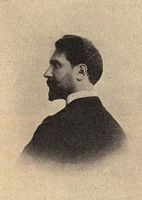
Georg Jarno (* June 3, 1868 in Ofen, Austria-Hungary; † May 25, 1920 in Breslau; actually György Cohner) was a Hungarian composer and kapellmeister who was successful especially with his operettas.
After completing his Abitur, Georg Jarno studied music in his hometown. Afterwards he moved to various opera houses in Germany. His stay in Breslau, where his first opera ''Die schwarze Kaschka'' was premiered on May 12, 1895 was particularly formative for him. Because it was well received by the audience, he followed it up with a second opera, ''Der Richter von Zalamea'' in 1899. The next station of his creative life was Hamburg. His Kleist opera ''Der zerbrochene Krug'' was performed there in 1903. Because it did not bring him the success he had hoped for, he later revised it into ''Johanniszauber''.
In 1907 Georg Jarno accepted an invitation to Vienna from his brother Josef Jarno, who was two years his senior. The latter had become director of the Theater in der Josefstadt in 1899 and in the meantime had married the Viennese soubrette Johanna Niese. He was looking for a composer who could write the leading role in an operetta for her. Together with the actor and journalist Bernhard Buchbinder, who also worked as a librettist, Jarno wrote ''Die Försterchristel''. On December 17, 1907, the work was premiered at the Theater in der Josefstadt. It was a triumphant success, not only for Jarno, but also for his sister-in-law, who made her breakthrough with it. Jarno was now granted the opportunity to live as a freelance composer. From then on, Bernhard Buchbinder was his main librettist.
Jarno had a respectable success with his operetta ''Das Musikantenmädel'' which premiered in 1910. Nowadays, of his works, only ''Die Försterchristel'' is performed from time to time at city theaters. His other works are forgotten today.
Towards the end of his life, Jarno returned to Wroclaw, where his compositional career had begun. He died there on May 25, 1920, shortly before his 52nd birthday.