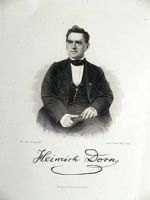
from Wikipedia:
Heinrich Ludwig Egmont Dorn (* November 14, 1804 in Königsberg i. Pr.; † January 10, 1892 in Berlin) was a German composer, conductor, and music critic.
Dorn initially studied law at the Friedrich Wilhelm University in Berlin from 1823, but then turned to the art of music. He was trained in piano by Ludwig Berger and Bernhard Klein and in composition by Bernhard Klein and Carl Friedrich Zelter. As early as 1826, his first opera, ''Roland's Squires'' for which he had composed the text himself, was performed to acclaim in Berlin.
Subsequently, Dorn temporarily took on a teaching position at a music institute in Frankfurt am Main and then as music director at the Königsberg Opera House. Here he premiered his second opera, ''Die Bettlerin'' (text by Karl von Holtei), in 1828. In 1830 he was appointed music director at the newly opened Electoral Court Theater in Leipzig. Here he became the composition teacher of Robert Schumann and Clara Wieck, among others, and staged the ballet ''Amors Macht'' as well as his third opera, ''Abu Kara'' (text by Ludwig Bechstein), in 1831, to little acclaim.
After the dissolution of these theatrical ventures, Dorn moved to Hamburg, where he temporarily directed the Hamburg Philharmonic. He then went to Riga, where he was given a position as the city's music director and, from 1836, at the same time the direction of the theater orchestra, where Richard Wagner was also active in the meantime as Kapellmeister in 1837-1839. Here, in 1836, Dorn organized the first and much acclaimed music festival of the Russian Baltic governorates and premiered his fourth opera, ''Der Schöffe von Paris'', in 1838, which was repeated everywhere to great acclaim, as well as his fifth opera, ''Das Banner von England'' in 1841.
At the beginning of 1843, Dorn moved to the ''Schauspiel Köln'' and succeeded Conradin Kreutzer as municipal bandmaster and concert conductor of the ''Gürzenich-Orchester Köln''. Two years later he founded the Rhenish School of Music and was also active here as a teacher of composition, singing and piano playing. In 1844 and 1847, Dorn was festival director of the Lower Rhine Music Festival in Cologne, at the former of which he performed Beethoven's Great Mass in D in its entirety for the first time in Germany.
After Otto Nicolai's death in Berlin in 1849, Dorn succeeded him as Kapellmeister and conductor at the Royal Court Theater and in the same year was also appointed a member of the Royal Prussian Academy of Arts in Berlin. However, unexpectedly, he was prematurely retired in 1869 with the title of professor, again together with his musical director Wilhelm Taubert. He then took on another position as a lecturer at Kullak's New Academy of Music in Berlin and as a music critic for the ''Neue Berliner Musikzeitung''.
Note: Translated from the German version of Wikipedia into English