Wikipedia:
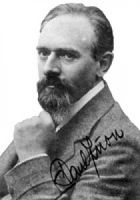
Paul Juon (actually Павел Фёдорович Юон/Pavel Fyodorovich Juon, * March 6, 1872 in Moscow, Russian Empire; † August 21, 1940 in Vevey) was a Swiss composer of Russian-Swiss descent who worked mainly in Germany.
Paul Juon was the son of the insurance clerk Theodor Friedrich Juon (b. 1842); his grandfather had come to Russia as a confectioner from Masein, Graubünden. His brothers were the painter Konstantin Juon and the mining engineer and Russian military officer Eduard Juon. Paul Juon studied at the Moscow Conservatory under Jan Hřímalý, Sergei Ivanovich Taneyev and Anton Stepanovich Arensky; in Berlin under Woldemar Bargiel. There he received the Mendelssohn Prize for composition in 1896.
From 1896 to 1897, he taught music theory and violin at the Baku Conservatory, then returned to Berlin, where in 1906 Joseph Joachim appointed him professor of composition at the ''Hochschule für Musik''. His students included Hans Chemin-Petit, Werner Richard Heymann, Nikos Skalkottas, Henry Jolles, Pantscho Wladigerow, Philipp Jarnach, Heinrich Kaminski, Lauri Ikonen, Georg Ahl, Max Trapp, Yrjö Kilpinen, Gerhart von Westerman, Hans Moltkau, Giannis Konstantinidis, Wilhelm Guttmann, Stefan Wolpe and Marc-André Souchay.
From 1934, he lived in Switzerland. In 1912, Juon married Marie, known as Armande (1874-1957). She had previously been the wife of the Basel composer Otto Hegner, who died in 1907. Together they had three children: Stella (1913-1988) and Irsa (1915-1996) and Rémi. They found their final resting place in the cemetery of Langenbruck.
Juon composed in an independent late romantic style four symphonies, a ballet, a piano and three violin concertos. In addition, he composed pieces for violin and orchestra, Épisodes concertants for violin, cello, piano and orchestra, chamber music works, sonatas for various instruments and songs. Juon's music is not lightly detailed, but formally sophisticated. He often used Russian or Nordic themes and transformed them by formal means into art music. At the same time he kept the timbre of the national music. Furthermore, he used rare time signatures, and the frequent change of time signatures is a characteristic of all his compositions. Paul Juon also created (ca. 1908, edition Simrock, Leipzig) at least one orchestration of a foreign composition. He arranged the piano version of the 4th dance from the Hungarian Dances by Johannes Brahms into an orchestral work.
Since 1995 his estate has been in the Cantonal and University Library of Lausanne. In 1998, the International Juon Society was founded.
Note: Translated from the German version of Wikipedia into English.