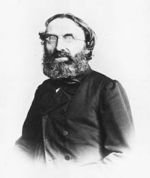
Weitzmann studied violin and composition with Carl Henning and Bernhard Klein in the mid-1820s, and composition and music theory with Louis Spohr and Moritz Hauptmann in Kassel from 1827 to 1832. In Riga, Weitzmann composed for a Liedertafel, which he founded in 1832 together with Heinrich Dorn. In Reval, now Tallinn, he was appointed music director and composed three operas. For ten years from 1836 he filled positions in St. Petersburg court orchestras; there he also began to collect rare music books and folk music. He then went on a concert tour of Lapland and Finland, followed by brief appointments to orchestras in Paris and London. In 1848 Weitzmann returned to Berlin, where he devoted himself to research in music history and theory. In 1857 he began teaching at Stern's Conservatory.
In 1853 Weitzmann published Der übermässige Dreiklang, wherein he demonstrated that a minor triad can be considered an "inverted" major triad, and how both can be produced from a common root. He also showed relationships between the augmented triad and these triad types. Franz Liszt may have been influenced by this work, as an analysis of his Faust Symphony suggests. In later writings, Weitzmann also applied his harmonic dualism to scales. These ideas were further developed by Arthur von Oettingen and Hugo Riemann.
In 1860 Weitzmann published a harmony system that was criticized several times. In his paper Die neue Harmonielehre im Streit mit der alten (The New Theory of Harmony in Dispute with the Old), he sought to counter this criticism. In his consideration of tuning systems, Weitzmann deviated from the opinion of most theorists: while many musicologists regarded tuning systems as a necessary compromise, Weitzmann was perhaps the first to take a consistently positive stance. He assumed equal temperament and outlined how the dissonant chords that occurred in it could be resolved.