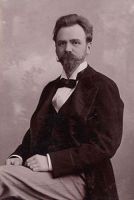
Jenő Hubay of Szalatna (* 15 September 1858 in Pest, Austrian Empire; † 12 March 1937 in Budapest), also known by his German name Eugen Huber, was a Hungarian violinist and composer. He was born Eugen Huber and changed his name at the age of 21 in the course of Magyarisation.
He grew up in a family of musicians. His father, Karl Huber (1827-1885), was a violin professor at the Academy of Music and Kapellmeister of the State Theatre in Bu-dapest and had composed, among other things, four operas and recital pieces for the violin.
Jenő was initially taught by his father and went to Berlin in 1873 to study with Joseph Joachim. He finished his studies in the spring of 1876 and returned to Hungary. Here he befriended Franz Liszt and joined him in numerous performances of Liszt's 12th Hungarian Rhapsody and Beethoven's Kreutzer Sonata.
In May 1878, on Franz Liszt's advice, he travelled to Paris, where he enjoyed great success as a violin virtuoso. In the following years he undertook successful concert tours in France, England, Belgium, the Netherlands and Hungary. Shortly after his return, he met Henri Vieuxtemps in Paris. In 1882 he was offered a professorship of violin at the Brussels Conservatoire, a post previously held by Vieuxtemps and Henryk Wieniawski. Hubay accepted the appointment to the principal professorship of violin.
In the summer of 1886, at the request of the Minister of Culture, he returned to Hungary to take up his father's post (head of violin training at the Budapest Academy of Music). He settled in Budapest and exchanged his life as a constantly travelling virtuoso for that of a composer and a leading figure in Hungarian musical life. On 21 December 1888 he played the premiere of Johannes Brahms' 3rd Violin Sonata (in D minor, op. 108) in Budapest from the manuscript.
From 1889 to 1900 he owned a Stradivarius built in 1726, of which Paganini was one of the previous owners and which is now called "the Hubay". In 1894 he married the Countess Róza Cebrian.
Together with the cellist David Popper, he founded the Hubay-Popper Quartet in 1896, in which Johannes Brahms, Ernst von Dohnányi, Wilhelm Back-haus and Leopold Godowsky, among others, played. It was one of the leading quartet formations for 30 years and served as a model for other quartets such as the Waldbauer-Kerpely Quartet, the Végh Quartet, the Roth Quartet and the Lener Quartet.
Hubay wrote four violin concertos. The 3rd Concerto in G minor, op. 99, published in 1908, was dedicated by Hubay to his then only 14-year-old pupil Franz von Vecsey, who also premiered it. It was a great success in London and Berlin. Hubay's 4th Violin Concerto op. 101 "Concerto all'antica" was premiered in Budapest in 1908. It has baroque forms in romantic orchestration.
In 1918 Hubay had to go into temporary exile, the next year he returned to his palace. In the 1920s he organised legendary afternoon concerts in his "White Music Salon" every Sunday, at which many celebrities of his time performed. From 1925, most of these concerts were broadcast on the radio, often with international coverage.
From 1919 to 1934 Hubay was director of the Academy of Music. He founded one of the world's leading violin schools.
He was invited by kings, heads of state, artists and church leaders throughout Europe. His friends included Mihály Munkácsy, Zsigmond Justh, Jules Massenet, Benjamin Godard, Felix Weingartner and Josef Krips.
During the communist dictatorship after 1956 in Hungary, Hubay's name was not allowed to be mentioned because he had been an "upper-middle-class aristocratic" artist.
Source: Wikipedia