Wikipedia:
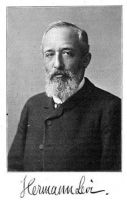
Hermann Levi (born November 7, 1839 in Giessen; died May 13, 1900 in Munich) was a German orchestra conductor and composer, with close ties first to Johannes Brahms and later to Richard Wagner. He conducted, among others, the important court orchestras (opera and concert) in Karlsruhe (1864-1872) and Munich (1872-1896). He also conducted for the Bayreuth Festival (1882-1894), especially the premiere of ''Parsifal''. His career was accompanied by the highest esteem for his musical, organizational and editing skills, but also by anti-Semitic hostility.
Hermann Levi was the son of the Hessian state rabbi Benedikt Levi. His father was Rabbi Samuel Levi of Worms, a son of Rabbi Wolf Levi in Pfersee near Augsburg. The family can be traced from Hermann back through at least ten generations (Hermann himself spoke of 14) to a paternal line of rabbis in the mid-16th century.
Hermann's mother Henriette (1807-1842) was descended from the Mayer family of tobacco manufacturers in Mannheim: her grandfathers were the Electoral Palatine court factor Gottschalk Mayer and the Mannheim bank founder Wolf Hajum Ladenburg. Henriette, with her "lively intellectuality and strong musical talent," became an attractive figure in Giessen society.
Hermann's older siblings were named Wilhelm and Emma. At the birth of the fourth child - Hermann was barely three years old - the mother died; the newborn was also not to remain alive for long.
In 1884, Benedikt married Gitel Worms, a merchant's daughter from Giessen, in his second marriage. She too died only a year later, after the birth of their daughter Auguste. Benedikt would never marry again.
Hermann's brother Wilhelm also studied music and became a singer. He later pursued a career in banking and became an authorized signatory of ''Bankhaus Ladenburg''. After his conversion to Catholicism, he called himself Wilhelm Lindeck. Through Hermann's mediation, he became the trustee of Johannes Brahms' assets for almost a decade.
Hermann Levi himself, at the age of 56 and already in such poor health that he could no longer conduct and had applied for retirement, married Mary Fiedler (1854-1919), a daughter of the art historian Julius Meyer and widow of the art historian Konrad Fiedler (1841-1895), on November 7, 1896. It was only a civil marriage. (this still during the lifetime of his father, with whom Levi had a very close relationship). In the marriage certificate, under the heading "Religious Affiliation", the notation "non-denominational" is entered. The couple had seriously considered the possibility of a Christian church blessing ("a priest would have been willing to do this"), but in the end felt it "more honest" to do without one.
Hermann Levi first grew up in Giessen. His extraordinary musicality manifested itself early; he was considered a pianistic prodigy in his hometown and played public piano concerts from the age of six. His father encouraged his two sons to pursue artistic careers, which was particularly noteworthy in light of the family's centuries-long rabbinic tradition.
At the age of twelve, Levi began musical studies in Mannheim (under the care of a great-aunt) with court conductor Vinzenz Lachner, while attending the ''lyceum''. From 1855 to 1858, he studied at the Leipzig Conservatory, from which he graduated with brilliant results, especially on the piano, in composition and conducting. After a study visit to Paris in the winter of 1858/59, he took over the post of music director in Saarbrücken after being recommended by Lachner. In 1861, he moved to Mannheim. From 1862 to 1864, he was chief conductor of the German Opera in Rotterdam, then until 1872 at the Grand Ducal Court Theater in Karlsruhe. In Karlsruhe he began with ''Lohengrin'' in 1864 and conducted ''Die Meistersinger von Nürnberg'' there in 1869, second only to the Munich premiere. He turned down the offer to conduct the premiere of ''Die Walküre'' in Munich in 1869.
A close friendly and artistic relationship with Johannes Brahms began in Karlsruhe; Levi performed numerous works by the composer in constant contact, including the premieres of ''Schicksalslied'', ''Alt-Rhapsodie'', ''Triumphlied'', ''Liebeslieder-Walzer'', and ''Klavierquintett''. With Brahms, six years his senior, Levi met "a first-rate musical personality whom he admired unreservedly and to whom he could subordinate himself with confidence". The intimate friendship was later to become estranged, however, and broke up in 1875 after a heated debate in which Levi's growing interest in Richard Wagner's music also played a decisive role. This marked the end of their artistic collaboration, even though Levi continued to perform works by Brahms (on a reduced scale).
During the Karlsruhe period, a close personal and multifaceted artistic relationship also developed with Clara Schumann, which lasted warmly throughout their lives. They understood how to keep Wagner, the "irritant" (also for Clara), largely out of their relationship; this is especially evident in their correspondence.
From 1872, Levi served as General Music Director and Court Kapellmeister at the Royal Court and National Theater in Munich, until he retired in 1896 for health reasons and settled in Partenkirchen. In 1872, he became a member of the ''Zwanglose Gesellschaft'' München,[15] of which he remained a member until his death.
In 1874, he conducted ''Tristan'' for the first time, becoming a "Wagnerian" by his own admission to Joseph Joachim, and the complete ''Ring'' in 1878. At the height of his career, Levi conducted the world premiere of ''Parsifal'' in Bayreuth in July 1882. Although he came from an important Jewish family, Levi had grown up in Wagner's Christian world of myths and had been on friendly terms with the composer since 1871. Wagner himself firmly rejected criticism that his "holiest" work should not be conducted by a Jew. However, Wagner always demanded that Levi be baptized. Levi never complied with this expectation, despite all his admiration for Wagner, but the external and above all internal conflict weighed heavily on him, as Levi's student Felix Weingartner recalled.
In February 1883 he visited Wagner in Venice, the day after his departure Richard Wagner died. Levi conducted the cycle of memorial performances of all Wagner's operas in Munich in March/April of that year. He remained the "major" and the right hand of Wagner's widow Cosima in directing the Bayreuth Festival until 1894. The continuing success of Richard Wagner's music after his death is closely linked to Levi's name. Anti-Semitic hostility, including from Richard Strauss, who in 1891 complained about the Jewish conducting of ''St. Parsifal'' to Cosima Wagner, also an ardent anti-Semite, weighed heavily on his mind.
Levi introduced the "Mozart cycle" into the German opera repertoire. He himself translated Lorenzo da Ponte's libretti for Mozart's operas ''Le nozze di Figaro'', ''Don Giovanni'' and ''Così fan tutte'' into German. In doing so, he skilfully endeavored to preserve as far as possible the vowels of the Italian original, which are important in singing; for example, in "Cinque... dieci.... venti... trenta... trentasei...quarantatre" (''Le Nozze di Figaro''), he translated the last numeral word not (literally) as "forty-three" but (preserving the vowel) as "yes, yes, it goes". These translations are still very popular today and have prevailed over other attempts at translation; many phrases from them have become catchphrases ("Reich mir die Hand, mein Leben"). A circumstance that was to embarrass the National Socialists: on the one hand, operas were to be performed only in German, and on the other hand, the libretto of the converted Jew da Ponte had also been translated by another Jew, namely Levi.
Levi initially pursued a career as a composer in his younger years: in Paris he wrote his op. 1, a piano concerto in A minor oriented on Schumann, which was premiered by the ''Leipzig Gewandhaus Orchestra''; he also wrote a symphony, a violin sonata, piano and chamber music, and various song settings. However, after harsh criticism of his works by Brahms, Levi abandoned this part of his musical activity despite great success and destroyed all manuscripts. All that has survived are the works that appeared in print, two song cycles, and the solo part of the piano concerto. The orchestral material of the piano concerto, thought lost, was rediscovered by the pianist and conductor Martin Wettges in the Zurich Central Library. He reconstructed the score from it and performed the work again on June 1, 2008 (Christian Schröder, booklet accompanying a performance of the piano concerto on February 4, 2014 in Giessen).
In Giessen's ''Musikerviertel ''a street is named after him, as well as in Munich's north (''Freimanner Heide''). In Bayreuth there is a ''Levistraße'' in his honor.[16] In addition, a bust by the sculptor Detlef Kraft was erected in the ''Theaterpark'' of the city of Giessen in 2007, on the pedestal of which the most important stations of Levi's life are reproduced on a plaque. The concert hall in the city hall of Giessen was renamed Hermann Levi Hall in November 2014. In 2017, the city of Karlsruhe named the square in front of the Baden State Theater after him.
Hermann Levi has also been an honorary citizen of the market town of Partenkirchen (from 1935 Garmisch-Partenkirchen) since 1898, where he had a villa built and he is buried in a mausoleum.
In 1925, the municipality named a street leading past Levi's mausoleum in the park of his Partenkirchen villa ''Haus Riedberg'' as ''Hermann-Levi-Weg'' in his honor. During the Third Reich (1934 or 1935), the street was renamed after Theodor Fritsch, a publisher of anti-Semitic inflammatory writings. After the war, when this name no longer seemed appropriate and the street was to be renamed again, the market community decided against the name Levi and in favor of the innocuous ''Karwendelstraße''. Plans to once again dedicate a street to the former patron of the community by renaming part of ''Hindenburgstrasse'' were scuppered by a referendum in 2013.
Levi was also laid to rest on the grounds of the villa. The body was initially buried temporarily in the parental grave of his widow Mary (née Meyer) at Munich's ''Ostfriedhof'' before the mausoleum, artistically designed by leading sculptor and close friend Adolf von Hildebrand, could be completed. The 4.80 m high, 4.50 m wide and 2.50 m deep structure, with its approximately 20 m wide green space ovally enclosed by a wall, survived the desecrations during the National Socialist era undamaged in substance.
Note: Translated from the German version of Wikipedia into English.