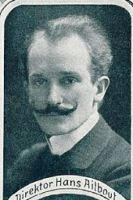
Hans Ailbout (* July 2, 1879 in Krefeld as Johann Franz Alibout; † September 1, 1957 in Berlin) was a German musician, music director and composer.
After studying music, Ailbout taught initially at the Krefeld Conservatory and from 1901 at the Stern Conservatory in Berlin. Around 1907, he founded the Mozart Conservatory in Berlin-Wilmersdorf and was its director from then on. His first wife, the concert singer Hilda Ailbout (Mathilde Dorothea Bahmer), also taught there, and he was married to her from 1905 to 1914. In 1917, he married Emma Siemon in his second marriage.
Ailbout published his works under his own name and under numerous pseudonyms, including E. Beker, Bell, E. Born, Jean Boutail, E. Brandt, F. Eilenburg, Hans Ernesti, H. Faneau, Jose Ferrin, F. K. Hu-ber, Konrad Kösen, H. Lange, and Torelli.
Hans Ailbout died in Berlin on September 1, 1957, at the age of 78. He was buried in the state-owned Wilmersdorf cemetery. The grave has not been preserved.
Ailbout's best-known set of melodies for wind orchestra is the fantasia ''Im Rosengarten von Sanssouci'' whose sheet music can be found in the holdings of the German National Library in Leipzig and elsewhere. Ailbout also composed film scores for such silent films as ''Das Kussverbot'', ''Miß Venus'', ''Die blonde Geisha'', ''Das Mädchen von Pontecuculi'', ''lm Teufelsmoor'', ''Heidehochzeit'', ''Beim Offenburg in der Heide'', ''Ernte im Wald'', ''Das Land der 1000 Wunder'' and others. Film scores for later sound films such as ''Betragen ungenügend'' (1933) or'' Die Bande vom Hoheneck'' (1934) were also part of his compositional œuvre.
With his military march ''Wir präsentieren'' (We present) he won 1st prize in a composition competition organized by the publishing house Scherl, Berlin, in 1912. In the same year, the march was included in the Prussian army march collection under the number I, 93, in the arrangement by the music director Oskar Hackenberger. At the largest equestrian procession in Europe, the annual Blutritt in Weingarten in Upper Swabia, the march is played by numerous bands. It is considered the "anthem of the Blutritt" and is also affectionately called the ''Rossbollen March''.
In the early 1920s, as conductor of the Potsdam Tonkünstler Orchestra, he recorded several records of march music.