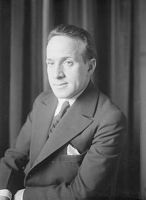
Nathaniel "Nat" Shilkret (* December 25, 1889 in New York City as Naftule Schüldkraut; † February 18, 1982 ibid) was an American musician, orchestra leader, composer and music manager.
Shilkret came from a musical family that had immigrated from Austria: his father played numerous instruments; most of his siblings were also active as musicians. In 1895, he was already learning the clarinet and violin; two years later he also received piano lessons. In 1896, he went on a nationwide tour with the New York Boys' Symphony Orchestra as a member; in 1902, he was heralded by the orchestra as a nine-year-old "phenomenon on the clarinet." In 1905, he was part of the Russian Symphony Orchestra and Arnold Volpe's orchestra, and in 1907, of the New York Philharmonic Orchestra (where he performed under the direction of Vasily Safanov and Gustav Mahler). Within the next decade, he belonged to the Metropolitan Opera Orchestra, Victor Herbert's orchestra, John Philip Sousa's Grand Concert Band, and the ensembles of Arthur Pryor and Edwin Franko Goldman. He also worked for Walter Damrosch and accompanied Isadora Duncan.
In 1915, he worked as an arranger and conductor for the foreign division of Victor Talking Machine Company (which later became RCA Victor) In 1921, he co-led the Shilking Orchestra with Eddie King, with whom they also made recordings. Beginning in 1923, he conducted John Philip Sousa's orchestra on recordings. In 1924, he formed his Victor Salon Orchestra, which recorded popular music in novel arrangements. In 1926, he became the director of light music at Victor.
With his orchestra and other musical groups, he made several thousand recordings, and from 1925 he also appeared with them on radio, first on WEAF Radio, then on NBC on the ''Eveready Hour'' and numerous commercial-sponsored broadcasts. Members of his orchestra included Jimmy Dorsey, Tommy Dorsey, Benny Goodman, Lionel Hampton, Glenn Miller, Artie Shaw, Mike Mosiello, and Del Staigers.
Shilkret was involved in numerous innovations in sound recording, notably the first "electric recording" in 1925 and a 1932 recording in which the voice of Enrico Caruso, recorded earlier (acoustically), was recorded electrically along with an orchestra. He also conducted Paul Whiteman's orchestra in the "electric" re-recording of George Gershwin's ''Rhapsody in Blue'' in 1927. He received a posthumous Grammy for his recording of Gershwin's ''An American'' in Paris in 1929.
Shilkret worked with George Gershwin, Jascha Heifetz, Mischa Elman and Andrés Segovia as well as with opera singers such as Rose Bampton, Feodor Chaliapin, Miguel Fleta, Amelita Galli-Curci, Mary Garden, Beniamino Gigli, Maria Jeritza, Giovanni Martinelli, John McCormack, Grace Moore, Jan Peerce, Lily Pons, Rosa Ponselle, Elisabeth Rethberg, Tito Schipa and Lawrence Tibbett.
Shilkret moved to Los Angeles in 1935 to increase his collaboration with the film industry. For RKO Pictures, he wrote the music for films such as ''That Girl from Paris'' (1936), ''Mary of Scotland'' (1936), ''Swing Time'' (1936, Academy Award for Best Song), ''Winterset'' (1936, Academy Award nomination), and ''Hitting a New High'' (1937). However, he was also involved in music production for ''Laurel & Hardy'' films at MGM: ''The Bohemian Girl'' (1936) as composer, and on other films such as ''Way Out West'' (1937) and ''Swiss Miss'' (1938) as conductor. He was also responsible for the music for animated films by Walter Lantz such as ''The Mysterious Jug'' (1937) and ''The Lamplighter'' (1938).
In the 1940s he founded his Nathaniel Shilkret Music Company (1940) to produce the music for films by MGM and for RKO-Pathe. In addition, he recorded records for Capitol Records. In the 1950s he was active mainly as a conductor. In 1963, after the death of his wife, he retired and moved back to New York.