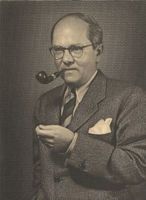
Wikipedia:
Richard Armstrong Whiting (* November 12, 1891 in Peoria, Illinois; † February 10, 1938 in Beverly Hills, Los Angeles County, California) was an American composer and lyricist whose film music appeared in over 450 films and who was nominated once for the Academy Award for Best Song and posthumously received the American Society of Composers, Authors and Publishers (ASCAP) Award for Most Performed Song in 1987.
Whiting worked as a composer and songwriter between 1919 and 1933, mostly for productions at Broadway musical theaters such as the musical revues Toot Sweet (1919) and Tip Top (1920). With Joseph Eldan and Raymond Egan, he wrote Sleepy Time Gal in 1925; in 1927 he collaborated as a composer for the first time on a film production, a film directed by Philip Braham about the singer and pianist Norah Blaney titled Norah Blaney. Whiting, who suffered from heart problems, wrote numerous well-known standard tunes until his death, such as "Ain't We Got Fun?", "On the Good Ship Lollipop", "Too Marvelous", "Japanaese Sandman" and "Louise", but also collaborated with Harry Akst and Gus Kahn on the 1931 jazz classic "Guilty". He also worked with composers and songwriters such as Buddy DeSylva, Raymond B. Egan, Neil Moret and Sidney Clare.
At the 1937 Academy Awards, he was nominated for the Best Song Oscar along with lyricist Walter Bullock for the song "When Did You Leave Heaven" from the musical film Sing, Baby, Sing (1936) directed by Sidney Lanfield and starring Alice Faye, Adolphe Menjou and Gregory Ratoff.
His songs continued to be used in over 450 films and television series well after his death, as well as for record productions by Lester Young such as the song "Too Marvelous For Words" composed with Johnny Mercer, or the song "Miss Brown to You" used for the album Carmen McRae Sings Lover Man and Other Billie Holiday Classics, a joint production by him, Leo Robin and Ralph Rainger. In 1987, Whiting, who was posthumously inducted as a member of the Songwriters Hall of Fame in 1970, was honored by the American Society of Composers, Authors and Publishers (ASCAP) with the award for most frequently performed song for the song "Hooray for Hollywood."
Whiting, whose grandfather Richard H. Whiting was a member of the U.S. House of Representatives from Illinois from 1875 to 1877, was the father of singers Margaret Whiting and Barbara Whiting.
Note: Translated from a German version of Wikipedia into English.