Wikipedia:
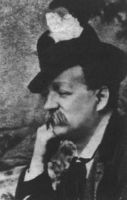
Leopold Knebelsberger (born September 15, 1814 in Klosterneuburg; died October 30, 1869 in Riga) was an Austrian musician and composer. He is best known for the melody of the Andreas Hofer song.
Leopold Knebelsberger received his first music lessons from his father, who served as sacristan and organist at St. Martin's Parish Church in Klosterneuburg for 65 years. His mother was the daughter of the village judge of Leobersdorf. Knebelsberger learned to play the violin and organ, as well as the hammered dulcimer and guitar.
After his great musical talent was noticed, he was trained in composition and harmony in Vienna by Conradin Kreutzer (1780–1849). Knebelsberger perfected his violin playing by taking lessons from Joseph Mayseder (1789–1863).
Until around 1843, Knebelsberger, about whose youth little is known, earned his living by giving music lessons. He also organized concerts in his hometown.
In Lübeck, Leopold Knebelsberger met the singer Anna Hellmrich and married her on July 31, 1849, in her Bohemian birthplace of Preßnitz. Although the couple purchased a property in Preßnitz and had ten children, they rarely spent time at home. Having already worked as a member of various singing societies, Knebelsberger founded his own vocal ensemble, the “Zillertaler,” in 1849. He undertook extensive tours through many European countries, often accompanied by his wife.
Leopold Knebelsberger died during a concert tour in Riga in 1869.
Although little is known about the whereabouts of his musical estate, his oeuvre is estimated to comprise around 300 folk songs and instrumental pieces.
His daughter Marie Knebelsberger became a virtuoso zither player and belonged to a women's band whose extensive concert tours took her to Egypt, among other places. In 1874, she married the Preßnitz watchmaker Auer. Marie Knebelsberger-Auer also composed music.
In the 1840s, Leopold Knebelsberger set to music a patriotic poem by Julius Mosen (1803–1867), a writer of the German Romantic period: “Zu Mantua in Banden” (1831). The verses, also known as the Andreas Hofer Song, were already quite popular in the German Vormärz era.
There are three theories about the origins of the composition, the sources of which remain unclear to this day:
1. In 1840, Knebelsberger was staying in Hart im Zillertal to recruit new singers for his ensemble. They introduced him to Mosen's poem, which inspired him to set it to music.
2. In 1844, Knebelsberger read the poem in a Dresden newspaper.
3. Knebelsberger is said to have met Julius Mosen in person in the 1840s and composed a catchy melody for the popular text using old folk tunes.
It is considered certain that in 1855 Leopold Knebelsberger deliberately directed one of his concert tours to Oldenburg, where Julius Mosen had worked as a dramaturge and had been confined to bed since 1846 due to a severe rheumatic disease. To Mosen's great delight, Knebelsberger's music ensemble performed the poem set to music for him.
On June 2, 1948, the Austrian province of Tyrol declared the Andreas Hofer Song the Tyrolean state anthem by law.