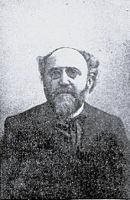
Karl Amadeus Wilhelm Häßler (* June 14, 1849 in Sondershausen; † January 2, 1914 in Lübeck) was a German bandmaster and composer.
His ancestors included Johann Wilhelm Häßler, "one of the finest minds" from the period between Bach and Mozart. His compositions gained renewed attention at the time of Charles' death.
Karl received violin and piano lessons from his father, the then princely chamber musician Louis Häßler († 1876). He then perfected his violin playing with the court concertmaster Wilhelm Uhlrich and learned theory from the court music director Frankenberger. All three were members of the princely orchestra.
From the age of 14 to 20, Häßler was a member of the court orchestra in Sondershausen. When he moved to Berlin, he took lessons with Heinrich Ehrlich and Franz Brendel (piano). He studied theory and composition with Friedrich Kiel and later with Eduard Marxsen in Altona, the latter being Brahms' teacher (harmony, counterpoint, theory of forms in music, theory of instruments).
His years of travel took Karl to the city theaters of Danzig, Stettin, Köln, Berlin (National Theater), Posen, Bremen and Aachen as a theater conductor. After the best testimonies of Max Bruch and Carl Reinthaler from Bremen, Hofkapellmeister Frankenberger from Sondershausen and others recommended him. He was elected chorus master of the Lübecker Liedertafel, which was then in great prosperity, on November 29, 1879. He was inducted into office by Eduard Hach on January 7, 1880.
Other associations also secured the services of the choral conductor. Thus Häßler acted at the head of the mixed Seemännischer Chor from 1886 to 1891 and of the Polyhymnia from 1886 to 1888. From 1881 to 1882, he was the conductor of the mixed choir in Eutin. In the late fall of 1891, he took over the direction of the Quartettverein Concordia. After its merger with the Lübecker Liederkranz in 1900, he took over the leadership of the Liederkranz Concordia, which was still flourishing at the time of his death. On Sunday, January 4, 1914, a concert of the association was to take place under his direction.
In 1886, Häßler was elected to replace the retiring Otto Dittmer as a member of the Federal Council of the Lower Saxony Singers' Association, to which he was to belong until his death. He demonstrated his competence in conducting mass choirs at the X. Lower Saxony Singers' Association Festival, which was held in Lübeck from July 30 to August 2. Together with Arnold Krug, he conducted the major concerts there. Their arrangement was to have an influence on the design of the programs of those concerts for years to come. Subsequently, he was also entrusted with the direction of the events in Itzehoe (1896), Bad Oldesloe (1898), Mölln (1900) and Segeberg (1908).
On the 25th anniversary of his conducting activities of the Liedertafel there, Häßler was honored for the elevation of German male singing and the direction of choirs at public events, his tireless promotion of the cultivation of music in the city, and his successful practical and theoretical training of numerous students, among whom were Karl Lichtwark or even members of the Senate, and he was awarded the title of professor by the Senate.
As a composer, Häßler appeared in public with a series of sound creations. With his own musical sound creations, such as the setting to music of a number of songs that frequently graced the programs of men's choral societies, namely those of northern Germany, and with the composition of several piano and orchestral works, he earned a name for himself that reached far beyond the borders of Lübeck.
He was considered to be an excellent pedagogue, and in his best years also an excellent piano player, whose interpretations of Bach and Mozart were particularly appreciated. Thus he had acquired a respected name as a sought-after teacher of music and singing, as he was able to awaken desire and love in his students for the noble art.
An eloquent sign of the high esteem in which he was held in life was the immense number of people who paid their last respects to him in the pouring rain at the Burgtorf cemetery. He passed away as a result of a heart attack. The singers, who owed him many successes, as well as numerous friends and many students paid their last respects to him in large numbers. The regimental band, with which he had often worked together, played funeral dirges at his grave. The Jakobi pastor Johann Georg Tegtmeyer, a former student of Häßler, held the funeral service, after which the Liederkranz Concordia sang the funeral hymn "In des Friedhofs stillen Gründen" composed by him. Mr. Dettmann, spokesman of the Lower Saxony Singers' Association, spoke at the open grave and vowed to continue to work in the spirit of the deceased.
The author of his obituary assumed that Häßler's city, which had become his second home, would create a lasting memorial for him. However, the war that began in the same year and the changes that followed caused Häßler to be forgotten.