Wikipedia:
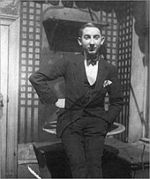
Mischa Spoliansky (* December 28, 1898 in Białystok; † June 28, 1985 in London) was a Russian-British composer (revue, film music) who worked in Germany from 1914 to 1933, together with Max Reinhardt, among others. The child of a family of musicians, he was educated in Dresden and Vienna. He went into exile in England in 1933.
Spoliansky was born into a Jewish, musically versatile family. His father Paul Spoliansky was an opera singer (baritone), his sister Lisa Schröder a concert pianist and his brother Aleksander (Shura) a cellist. After Mischa was born, the family moved to Warsaw, later to Kalisz. After the early death of his mother, the five-year-old moved to Vienna with his father. Spoliansky's early musical education (piano, violin and cello) continued with Mark Günzburg in Dresden. Mischa gave his first public performance at the age of ten. His father died soon afterwards and Spoliansky moved to Königsberg to live with relatives, but had to flee to Berlin in 1914 due to the outbreak of war, where his brother worked as a cellist and his sister studied with Artur Schnabel. He initially began an apprenticeship at the fashion house Hermann Gerson, but broke it off. Spoliansky worked as a pianist in coffee houses in order to finance his music studies at the Stern Conservatory. Spoliansky's first compositions were played by the UFA film theater orchestra in Friedrichstraße. He also worked as a composer and pianist in a Russian émigré cabaret. It was there that Friedrich Hollaender and Werner Richard Heymann heard him and invited him to compose and play for the literary cabaret Schall und Rauch in the basement of the Großes Schauspielhaus, which Max Reinhardt had founded in 1919. Spoliansky also played at the renowned Bar Kakadu. Spoliansky set texts by Kurt Tucholsky, Klabund and Joachim Ringelnatz to music and accompanied stars such as Gussy Holl, Paul O'Montis, Rosa Valetti and Trude Hesterberg on the piano. In 1920, under the pseudonym "Arno Billing", he composed the melody for the first homosexual anthem entitled ''Das Lila Lied'', which he dedicated to Magnus Hirschfeld and which was also published with different lyrics as Sei meine Frau für vierundzwanzig Stunden.
In 1920, he founded Heiki Internationaler Musikverlag GmbH with the businessman Fritz Heymann.
In 1922, he met the poet Marcellus Schiffer and the diseuse Margo Lion, and in the same year he married the dancer Elsbeth (Eddy) Reinwald. In 1926, Spoliansky accompanied Richard Tauber on the recording of Schubert's Winterreise. Marlene Dietrich appeared in his revue ''Es liegt in der Luft'' (text by Marcellus Schiffer) in 1928. A year later, she was discovered in Spoliansky's ''Zwei Krawatten'' (text by Georg Kaiser) by Josef von Sternberg, who was looking for the leading actress for Der Blaue Engel.
This was followed by 1930's ''Wie werde ich reich und glücklich?'', 1931's ''Alles Schwindel'', 1932's ''Rufen Sie Herrn Plim and Das Haus'' dazwischen, 1933's ''100 Meter Glück''.
Spoliansky emigrated to London in 1933. There he began a second career as a film composer. His rapid naturalization as a British citizen was achieved not least thanks to the hit song ''Heute Nacht oder nie'' from the film ''Das Lied einer Nacht'' (1932), which brought Spoliansky worldwide fame. In exile, he composed the anti-fascist ''Lied vom Stacheldraht'', which was sung by Peter Illing.
Recently, theaters have occasionally performed works by Spoliansky again, for example ''Zwei Krawatten'' in the 2004/2005 season at Theater Dortmund and in 2009 at Theater Rudolstadt and 2015/16 at Deutsches Theater Göttingen and in 2022 at Staatsoperette Dresden, or ''Rufen Sie Herrn Plim'' at Städtische Bühnen Münster (2002/2003) and later at Theater in Kassel. Excerpts from ''Rufen Sie Herrn Plim'' were performed in January 2010 at the Kulturzentrum Schlachthof in Bremen by the choir of the University of Bremen under the direction of Susanne Gläß. In 2019, the University of Bremen Choir repeated the performance twice. And in 2017, the Nationaltheater Mannheim staged its 1930 cabaret revue ''Wie werde ich reich und glücklich?''
Note: Translated from a German version of Wikipedia into English.