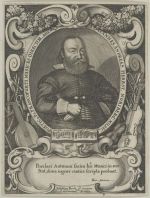
Johann Andreas Herbst is one of the most versatile musical personalities of the Schütz generation in the southern German-Franconian region. He was a contemporary of Michael Praetorius and Heinrich Schütz. His years as an apprentice in his home town of Nuremberg familiarized him with the works of Lasso, Lechner and Hassler. It is possible that he received his training from Hans Leo Hassler, as he worked in Nuremberg during Herbst's youth and their styles are similar. Herbst found his first position as Kapellmeister at the court of the music-loving Landgrave Philipp V of Hesse in Butzbach in 1614 and at the court of Darmstadt in 1618. The turmoil of the Thirty Years' War hit Darmstadt hard: the chapel had to be reduced in size and when Landgrave Ludwig V was taken prisoner in May 1622, Herbst intensified the contacts he had already established with the Frankfurt am Main City Council in previous years with the dedication of five motets (Cantiones sacrae) for New Year 1623. As early as September of the same year, he was able to take up the newly created position of municipal music director in Frankfurt, which involved the direction of church music at the main Protestant church, the Barfüßerkirche.
Herbst earned lasting merit with a fundamental reorganization of musical life in Frankfurt and set standards for later times.
Between 1636 and 1644, he went to Nuremberg as Kapellmeister at the Frauenkirche, but then returned to Frankfurt. In addition to numerous, largely unpublished compositions, he left behind several music treatises in German, the historical value of which has only recently been fully recognized.
He introduced Venetian polychoral music to the Protestant part of Germany. Philipp Friedrich Buchner was one of his pupils.
In addition to numerous, largely unpublished compositions, he left behind two music treatises, Musica Practica and Musica Poetica, whose historical value was long unrecognized.
(Peter Cahn and Wikipedia)
Note: Translated from a German version of Wikipedia into English.