Member of a copyright collecting society (ASCAP, BMI, GEMA, VG, etc.)
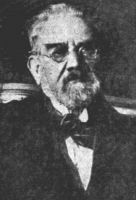
Spanish musician, composer and music critic.
He studied music theory, flute and harmony in his home town. At the age of fourteen, he moved to Lisbon, where he perfected his literary and musical knowledge, learned composition and gave concerts. On his return to La Coruña, he was appointed director of the Carballo band and wrote the Opúsculo sobre la Música (Little Book on Music), which served as a text for the students of the corresponding music society. In 1877, he founded and directed'' El Eco Musical'', a weekly magazine for literature and the visual arts, which published 45 issues. He collaborated on ''La España Musical and El Correo de Teatros'' in Barcelona,'' El Globo'' in Madrid and directed ''El Coliseo'' in Barcelona (1879) after moving to Barcelona. He then moved to Madrid, where he edited ''La Correspondencia Musical'' and ''El Nuevo Fígaro'' and later collaborated on the ''Enciclopedia Musical de Barcelona''.
Later he was director of the ''Boletín Musical de Madrid'' for six years. He has conducted orchestras and bands as well as the ''Orfeón Normal de Madrid''.
At the age of twenty, he began to compose an opera in three acts and to collect material for the publication of a technical and music-historical dictionary, but his teachers advised him against this project and both works remained only in draft form. He engaged in fierce polemics with Eslava, Saldoni and Barbieri about technique and music history.
The dispute that he courageously waged with the latter over scores, guitar numbers and medieval organ parts lasted more than three months and marked him out as a serious and learned polemicist who attracted a great deal of public attention, which was reflected in congratulations from the most important masters of his time.
In 1893 he won first prize in the scientific literary competition in the then city of Gracia (Barcelona) for his work ''Pasado, presente y porvenir del canto coral humorístico'' and in the same year he set to music the popular anthem ''¡Galicia!'' by Galo Salinas, dedicated to the ''Junta de defensa de La Coruña'', whose music, intended for solo voices, was later instrumentalized for the Galician folk bands. In 1896, the Faculty of Music of the city of Palma de Mallorca awarded him an artistic silver crown.
In July 1899, the anthem that Varela Silvari had composed for the Salesian institution was sung for the first time at the Salesian festivities in Turin with the participation of large choral and instrumental ensembles, a premiere that was a complete success. In 1910, he was invited by the University of Coimbra to write a triumphal march for military bands for the great celebration that took place that year to mark the centenary of the birth of the historian Alexander of Herculaneum.
The government wanted to honor him by awarding him the'''Santiago Habit'', which Varela Silvari declined, and he also declined various honorary awards that were to be bestowed on him by various bodies. In 1911, he presided over a competition of civil and military bands in Porto and gave a speech with lively and patriotic tones.
In 1913, the exercises for the post of senior military musician were changed, and in the absence of a music history text, which was one of the variants required in the new exercise program, Varela Silvari wrote the draft ''Boceto para un curso breve y razonado de historia general de la música'' (Draft for a short and well-founded course on the general history of music), which was enthusiastically received. In 1916, the city council of La Coruña decided to name the street where the artist was born after Varela Silvari, and public celebrations were held in the composer's honor.
In 1918, in the middle of the First World War, on the maestro's 70th birthday, all the European music associations made a public act of salute and sympathy in his honor. In Spain, several European music associations, the authorities, the press and the businesses of La Coruña supported the European act; an act that had an impact in Spain, as several European music associations from different places as well as the authorities, the daily press and the businesses of La Coruña supported the European salute. On July 5, 1925, an international tribute to the composer was held at the Palacio de la Bolsa in Madrid, attended by representatives of numerous European capitals. In a unique case of enthusiastic welcome and applause from abroad for a Spanish artist, the same associated companies repeated their public acclaim in writing in a detailed telegraphic message that was reproduced in the Spanish press.
He was master composer of the Philharmonic Academy of Basel, honorary member of the first class of the former Quartet Society of Lisbon, professor at the Philharmonic Institute of Madrid and director of the Santa Cecilia Music Chapel. He was a pensioner of the Portuguese government, promoter of the Swiss choral associations, honorary president and advisor of the Brazilian Music Concert Association, decorated in Switzerland, Italy and Portugal, corresponding member of the Real Academia Lisboeta de Amantes de la Música, honorary composer of the Academia Filarmónica de Bolonia, among other titles and awards. Among the writings published in honor of Varela Silvani is the ''Loa'', which was read at the Instituto Filarmónico de Lisboa in 1891 on the occasion of the installation of the portrait of this Galician musician in its auditorium.