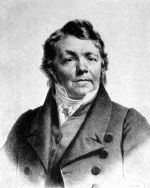
Jan (Johann) Nepomuk Hummel (1778-1837) was born in Bratislava (Pressburg; Pozsony), the son of Josef Hummel, Director of the Imperial School of Military Music and Conductor of the Theater Orchestra. Josef selected the violin as Jan's first musical instrument, but this led to failure; the boy chose the pianoforte.
Jan immediately displayed a most remarkable ability and at age 7 when his father moved to Vienna, Mozart was so impressed with the child's playing that he offered to give him music lessons. Hummel then lived with Mozart for 2 years and in spite of informal and irregular lessons, he made immense progress, and Mozart predicted a brilliant future for him.
At age 9, Hummel made his first appearance at a concert given by Mozart. So successful was this performance that his father decided to take the boy on a European tour a year later through Bohemia, Germany and Denmark and the British Isles, ending in London, where the boy received instruction from Clementi. At age 10, he gave a concert at Oxford which included an original piano quartet. Hummel remained in London until the age of 14 and toured his way home to Vienna in 1793.
When he was 15 years of age, he devoted himself to the study of composition under the senior master Albrechtsberger and at Haydn's suggestion sought dramatic compositional advice from Salieri. His performance tours took him into Russia.
At age 26, he accepted the revered post of Kapellmeister to Prince Esterhazy at Eisenstadt, a position formerly held by Haydn. Hummel remained here until 1811. It was during this time that an unusual estrangement came between him and Beethoven. This circumstance remained throughout Beethoven's lifetime, and it was not until Beethoven's last days that the old misunderstanding faded away.
Hummel was dismissed from this post for neglecting his duties and then moved back to Vienna. His career then embraced a great deal of touring as performer and conductor throughout Europe and Russia. After 1819, he lived in Weimar where he was a close friend of Goethe and often performed at the poet's house. Together they were considered one of Weimar's most popular tourist attractions. "Without seeing Goethe and hearing Hummel play, no visit [to Weimar] was complete." During his stay at Weimar, Hummel composed many of his greatest works, including the Piano Sonata, Op. 81; Grande Sonata, Op. 92 as well as his piano method: "A Complete Theoretical and Practical Course of Instruction on the Art of Playing the Piano Forte" (1828). This method sold thousands of copies within days of its publication and brought about a new style of fingering and ways of playing ornaments. Hummel was an astute businessman and was instrumental in establishing European copyrights for musical compositions.
In appearance, Hummel was a large man and rather ungainly. His face was that of a healthy business man with an abundance of common sense and savoir-faire. He married Elisabeth Röckel, an opera singer, in 1813.
Hummel was considered a brilliant virtuoso and wherever he appeared, he achieved very distinct success. He had the gift of improvisation, rivaling that of Beethoven, and was highly respected not so much for the performance of his own compositions, but rather for his interpretation of other composers. It is interesting to note that the symphonies of Beethoven became known to many people through the medium of Hummel's piano duet arrangements of his colleague.
It was this element of interpretation that altered the system of musical ornamentation. Prior to Hummel, trill notes began upon the auxiliary note, a style attributed to C.P.E. Bach. Hummel's suggestion was to start the ornamentation upon the principal note and that has remained with us to this day.
It should also be noted that Czerny was a pupil of both Beethoven and Hummel and that the playing of Hummel was a "revelation to him," and that he, in turn, was a teacher of Liszt. Therefore, our modern piano school can be traced to him. Not only pianists, but composers felt Hummel's influence, clearly evident in the early works of Chopin and Schumann. He was considered in his time to be one of Europe's greatest composers and perhaps its greatest pianist.
Grove's Dictionary of Music lists over 175 compositions and stage works, church music, orchestral works, piano and orchestral works, chamber music, a host of solo instruments with piano, and a very impressive repertoire of piano solos.