


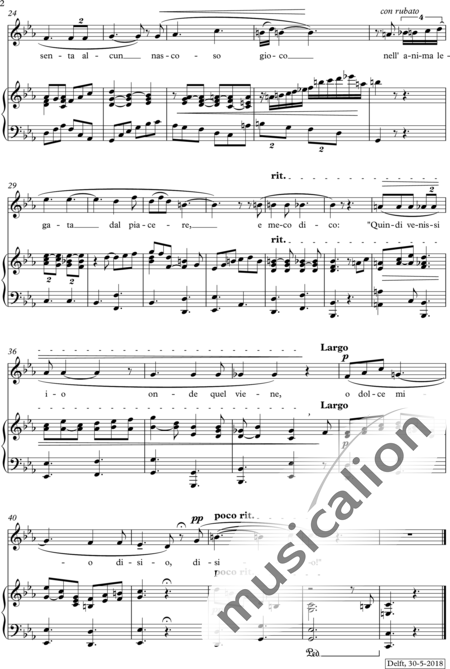
Wytze Oostenbrug : L'udir talvolta nominare il loco
Giovanni Boccaccio was born in Paris in 1313. He was the son of a Frenchwoman and a Tuscan merchant father and died in Certaldo, Tuscany, on December 21, 1375. He spent his early childhood in Florence. At the age of 15, he was sent to Naples for trade apprenticeship. Here he gained experience of court life and its intrigues.
It was in Naples that he met his mythical love ''Fiammetta'' who was to shape his entire literary oeuvre. Incidentally, the true identity of Fiammetta remains obscure. It was here in Naples that he wrote his first great works.
He developed into perhaps the most famous poet of the 14th century. Together with Petrarch whose work he had already become acquainted with in Naples, he paved the way for the Renaissance and humanism. His most famous work is the ''Decameron''.
He developed the ''ottava rima'', an ABABABCC rhyme scheme with 8 lines of 11 syllables. Thereafter, he used this scheme for all the great narrative poems.
Boccaccio sought to enrich the previously common themes of chivalry and love in Latin poetry with real-life experiences. He gave poetry a place in the Italian language. His design of the ottava rima was adopted by minstrels and thus gained an important place in Italian literature.
L'udir talvolta nominare il loco
This poem is from the work ''Il Filostrato'' (1335-1340), section 6, verse 67. The version of ''L'udir talvolta'' is from the edition: ''Letteratura italiana Einaudi, Edizione di riferimento: Filostrato , a cura di Vittore Branca, in Tutte le opere, a cura di V. Branca, vol. II, Mondadori, Milan 1964''.
It tells the story of the love of Troilus and Criseida. In this poem the lovers are not together. Troilus describes the vision when he hears about the place where Criseida lives, or about someone who comes from there. Movement in it ignites the fire.
It was in Naples that he met his mythical love ''Fiammetta'' who was to shape his entire literary oeuvre. Incidentally, the true identity of Fiammetta remains obscure. It was here in Naples that he wrote his first great works.
He developed into perhaps the most famous poet of the 14th century. Together with Petrarch whose work he had already become acquainted with in Naples, he paved the way for the Renaissance and humanism. His most famous work is the ''Decameron''.
He developed the ''ottava rima'', an ABABABCC rhyme scheme with 8 lines of 11 syllables. Thereafter, he used this scheme for all the great narrative poems.
Boccaccio sought to enrich the previously common themes of chivalry and love in Latin poetry with real-life experiences. He gave poetry a place in the Italian language. His design of the ottava rima was adopted by minstrels and thus gained an important place in Italian literature.
L'udir talvolta nominare il loco
This poem is from the work ''Il Filostrato'' (1335-1340), section 6, verse 67. The version of ''L'udir talvolta'' is from the edition: ''Letteratura italiana Einaudi, Edizione di riferimento: Filostrato , a cura di Vittore Branca, in Tutte le opere, a cura di V. Branca, vol. II, Mondadori, Milan 1964''.
It tells the story of the love of Troilus and Criseida. In this poem the lovers are not together. Troilus describes the vision when he hears about the place where Criseida lives, or about someone who comes from there. Movement in it ignites the fire.


Recomendado:
 Quizás sea apropiado:
Intérprete: Oostenbrug, Wytze
Añadido por: WytzeO
Añadido en fecha: 10.03.2023
0:00/0:00
Añadido por: WytzeO
Añadido en fecha: 10.03.2023
 Descargar
Descargar partituras
|



| Añadir archivo mejorado |

Si usted ha realizado una correción de escritura, nos haría un gran servicio informándonos aquí de ello. Por favor especifique cuál ha sido el archivo modificado. Por cada corrección que usted publique se le prolongará su membresía en una semana!
|
 Practica ahora

Musicalion Player
Haga una audición de voces individuales.
 Marcar y compartir

| Época/Estilos: | Siglo XXI |
| Tema: | Amor |
| Categoría: | |
| Dificultad: | Mediana |
| Ejecución: | La ejecución de la obra es libre (GEMA, SUISA, AKM etc.) |
| Instrumentación: |
Voz sola con un instrumento
Solo>X+Piano
|
| Idioma del texto: | Italiano |
| Número de páginas: | 2 |
| Contribución de: | WytzeO |
| Visitas: | 376 |
Composiciones similares
Categoría: Lyrics put to five songs from Stevie Smith, Tema: Amor
Instrumentación: Solo>X+Piano, Dificultad: Mediana

Categoría: Boccacio Songs, Tema: Amor
Instrumentación: Solo>X+Piano, Dificultad: Mediana
Categoría: Boccacio Songs, Tema: Amor
Instrumentación: Solo>X+Piano, Dificultad: Mediana

