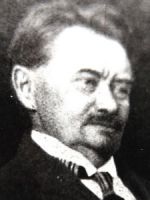
Anton Beer-Walbrunn saw the light of the world on 29 June 1864 in Kohlberg in house number 21a, today "Weidner Strasse 2" and died on 22 March 1929. His father Anton Beer (born 1825) worked as a catholic teacher of the market town from 1855 to 1866 and simultaneously as a choirmaster still at that time at St. Nicholas Church. The name of his mother (born 1828) was Margareta, her birth name Walbrunn. The musical impact, which dissolved early, she had left with her son led to the appearance of his double name Beer-Walbrunn in her honor in 1904. After being in Kohlberg the family moved to the neighboring area of Mantel, later settling in Neukirchen-Balbini. In Mantel the just five year old Anton Klavier was taught piano and organ by his father so that Anton could promptly conduct church service in the community early on. His training was tailored to the teaching profession and he attended seminary in Amberg. On the basis an excellent final examination and the advocacy of the Eichstätter Director of Music Wilhelm Widmann, training could be extended for a further three years studying at the Academy of Music in Munich with Joseph Rheinberger. Longer time of free, creative work followed. The composer was allowed the pleasure of insistent patronage by Adolf Graf von Schack. During this creative phase organ, piano, chamber and orchestra music pieces were created. For the time of composition the principle holds true for Beer-Walbrunn according to traditional annotation: "The Prophet is nothing in his own country“. As a composer, who was rooted in romantic tradition, he no way refused as well progressive tendencies to the predominating Zeitgeist. One noticed him in his Bavarian homeland at best reservedly. Beer-Walbrunn composed among other things songs and pieces of choral music, for example the “Shakespeare Sonnets” or also several operas entitled “The Atonement”, “Don Quijote”, “The Monster” and “The Storm”. Many of his works never received the recognition that he had expected. This is to quote different contemporary sources.
Beer-Walbrunn harvested far more renown in his ability as a music teacher. Shortly after the turn of the century in 1901, he was appointed as a teacher for composition, counterpoint, harmonic theory and piano at Academy of Music in Munich. The appointment to professor took place in 1911. With proverbial conscience he fulfilled his duty, which claimed precisely in those stirring times of profound stylistic processes of change a maximum of artistic, mental and human superiority.
Among his pupils who profited effectively from his work method ranked as famous composers are Wilhelm Furtwängler, Fritz Büchtger or Carl Orff. Orff said for example about Anton Beer-Walbrunn: "He was very willing and an exceptionally kind teacher, a "Spitzweg" figure with a lot of self-irony, a master of old school with great ability and knowledge“. Further prominent pupils were Alfred Einstein, Eugen Schmitz or Heinz Pauels. On 22 March 1929 shortly before his retirement the native Kohlberger Anton Beer-Walbrunn as a music teacher of high repute and creative composer laid to rest in Munich, embittered over the small attention of his dramatic works and to attain without the supraregional celebrity, which he had anticipated his whole life. The city of Munich has preserved a memorial named after him in a road in Obermenzing. The artist and teacher remained rather unknown in his Oberpfaelzer homeland.