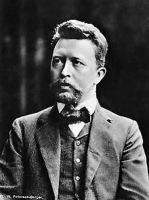
Wilhelm Peterson-Berger (born February 27, 1867 in Äskja gård, Ullånger; died December 3, 1942 in Östersund) was a Swedish composer and music critic.
Peterson-Berger's first musical impressions came as a child from his mother, a gifted pianist who played Beethoven and Chopin. These made such a deep impression on him that he later incorporated them into his piano pieces "Fyra Danspoem". In 1885, at the age of 18, Peterson-Berger went to Stockholm to attend the conservatory. Here he studied composition with Joseph Dente, a student of Franz Berwald, among others. A performance of Richard Wagner's "Meistersinger" in Stockholm in April 1887 left a deep impression. Peterson-Berger had been interested in Wagner since his school days. Wagner was not only a musician for him, but a cultural phenomenon. Peterson-Berger later translated some of Wagner's writings into Swedish.
In 1888, at the age of 21, Peterson-Berger passed his conservatory exams and went to Dresden to study. Two years later he returned to Sweden and taught music in Umeå in Västerbotten (Norrland). One year before, during a summer stay, he got to know the landscape of Jämtland (Norrland), which was to become decisive for his further life and work. The nature and landscape of Jämtland became sources of inspiration for his music (for example in the piano pieces "Frösöblomster" and in his opera "Arnljot"). Outdoor life and hiking tours of several weeks through the northern Swedish landscapes became an important recreation for Peterson-Berger which served as a a retreat from civilization. Peterson-Berger wrote about his hikes in the yearbooks of ''Svenska Turistföreningen''. The cycle "En Fjällfärd" (A Mountain Hike) for male choir from 1893, which he composed himself, is also directly linked to hiking experiences.
But Peterson-Berger did not stay in Umeå for long: at the age of 25 (1892) Peterson-Berger was called to Dresden as a music teacher. But Dresden could not really captivate him. After only two years, he returned to Sweden and settled in Stockholm a year later. Here, at the age of 29, he took one of his most momentous steps: he became a music critic for the important Swedish daily newspaper ''Dagens Nyheter''. His reviews, with the acronym P.-B., soon became some of the most feared in the entire country. P.-B. made lifelong enemies with his relentless demand for truth and simplicity, his rejection of everything artificial and contrived, and became an increasingly isolated figure in Swedish musical life.
In addition to his critiques, Peterson-Berger published numerous writings that are still worth reading today, especially his analysis of Richard Wagner's "cultural phenomenon." The increasing isolation also found expression in the external circumstances of his life when, at the age of 43 (1910), Peterson-Berger bought a piece of land on Frösön, an island in Lake Storsjön in Jämtland near Östersund, on which he built a house four years later in the midst of the unspoiled landscape - with a view of Oviksfjället, one of his favorite mountains. He died here in 1942, at the age of 75.
Wikipedia:
Note: Translated from the German version of WIkipedia into English.